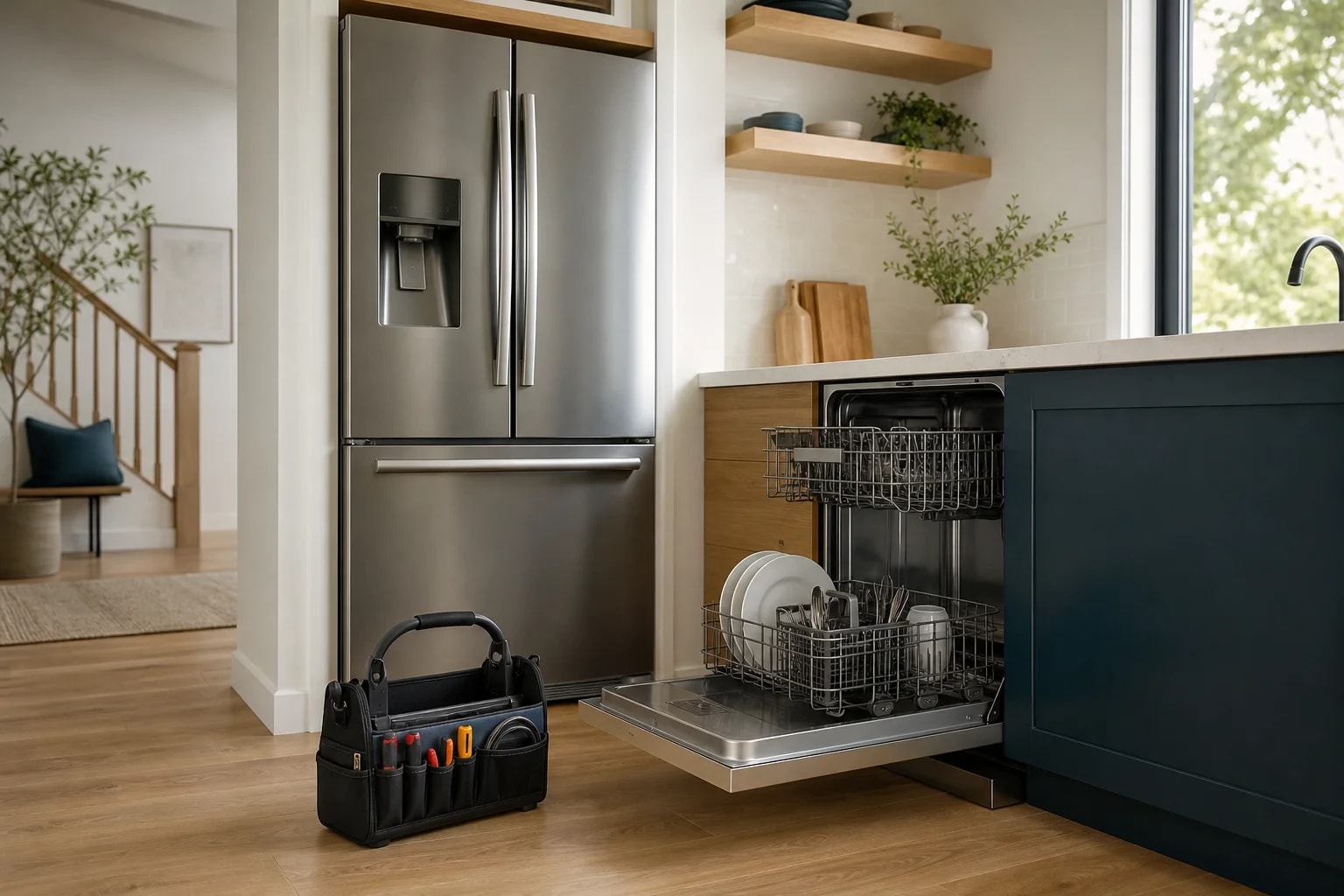
Dishwasher trouble comes in four main flavors: water left in the bottom after a cycle, dishes that come out dirty or gritty, a machine that will not start or stops partway, and water on the kitchen floor. Each has a short list of usual causes, and several of them overlap.
This guide covers the common faults, what you can look at without pulling the dishwasher out or opening anything but the door, the signs that mean stop using it and call, and what a dishwasher repair typically costs.
What you notice
- An inch or more of water sits in the bottom of the tub after the cycle ends.
- Glasses come out cloudy or gritty, and food is still stuck on plates.
- The dishwasher hums or clicks when started but water never enters, or the cycle stops partway with an error code.
- Water appears on the floor in front of or under the dishwasher during a cycle.
- Detergent is still in the dispenser cup at the end of the wash.
- A sour smell from the tub even after a cycle, or a grinding or rattling noise during the wash.
Likely causes
A clogged filter, sump or spray arm
Most modern dishwashers have a removable filter in the floor of the tub. Food, labels, seeds and glass catch there, and a dirty filter leaves water in the tub and grit on the dishes. Spray arm holes clog the same way and leave the top rack dirty.
A blocked drain path: hose, air gap or disposal
The drain hose runs to the sink drain or a garbage disposal. A kinked hose, a clogged air gap on the counter, or a disposal that is itself clogged stops the dishwasher from draining. After a new disposal is installed, a knockout plug left in place blocks the dishwasher completely.
A failed drain pump, wash pump or motor
The pump moves water through the spray arms and out the drain. A broken impeller, a seized motor or a piece of glass in the pump shows up as poor cleaning, a grinding noise, or water that will not leave.
A door latch, float switch or water inlet valve
The machine will not start if it thinks the door is open. A stuck float or a failed inlet valve means no water enters, so the dishwasher runs dry and cleans nothing.
A leaking door gasket, tub seal or hose
A hard or torn door seal leaks at the front corners. A pump seal or loose hose leaks underneath and often shows only as a wet cabinet floor or warped toe-kick.
Detergent, water temperature and loading
Old clumped detergent, no rinse aid, cold incoming water and dishes blocking the spray arms account for a surprising share of dirty-dish complaints. A technician checks these before touching parts.
Safe things to check before anyone comes out
- Open the door and look at the bottom of the tub: standing water, visible debris, and whether the spray arms spin freely by hand.
- Look at the detergent cup after a cycle. Detergent still inside means water or the spray arms never reached it.
- Run the kitchen sink for a moment. If the sink drains slowly or backs up, the problem is the sink drain, not the dishwasher.
- If there is a small chrome cap at the back of the sink (an air gap), look for water around it during a cycle. Water from the cap means the hose past it is blocked.
- If the dishwasher shares a drain with a garbage disposal, run the disposal with water for a few seconds; a clogged disposal blocks the dishwasher.
- Check the display for an error code and write it down.
- Look at the door gasket for food debris, tears or a corner that has pulled out of its channel.
- Note where any water appears on the floor: the front corners of the door point to the gasket, the toe-kick area points to something underneath.
When to stop and call
- There is smoke, a burning smell, sparking, or water near the outlet or electrical parts under the sink. Stop the dishwasher and have its breaker turned off if that can be done safely.
- Water is spreading across the kitchen floor or into the cabinet below while the machine runs. Cancel the cycle and stop using it until it is checked.
- The dishwasher trips the breaker when it starts.
- A strong hot-plastic or electrical smell during a cycle.
- The machine fills on its own while it is off, which points to a stuck inlet valve and can flood the kitchen.
What the technician does
- Asks what the machine does and does not do, reads any error code, and checks the sink drain, air gap and disposal connection.
- Removes the lower rack, filter and spray arms, and clears the sump of debris and glass.
- Checks the drain hose along its run for kinks and clogs and confirms it has the high loop or air gap it needs.
- Tests the drain pump, wash motor, inlet valve, float switch and door latch with a meter, and runs a diagnostic cycle on models that have one.
- Finds leaks by running the machine with the toe-kick off and watching the door seal, pump seals and hoses.
- Replaces the failed part, reassembles, and runs a full cycle to confirm it fills, washes, drains and stays dry.
- Explains the cause and goes over loading, detergent and filter cleaning so it does not come back.
What it usually costs
Many dishwasher visits end with a cleaned filter and sump, a cleared hose or a disposal plug removed, which costs little more than the diagnostic fee. Replacing a drain pump, inlet valve, door latch or gasket usually lands in the low to mid hundreds of dollars with labor. A wash motor or control board costs more and can approach the price of a basic new dishwasher. The estimate should be explained before any work starts.
What moves the estimate
- Whether the fix is cleaning and clearing or a replacement part.
- Which part failed: gaskets and latches are quick, pumps and motors take longer.
- Brand and model, especially for panel-ready and premium units.
- Access: a dishwasher that was tiled in or has a tight countertop takes longer to pull.
- Whether a plumbing issue at the sink or disposal is part of the job.
Keeping it from coming back
- Rinse the filter under the tap every few weeks. It twists out of the tub floor on most models; the technician can show you.
- Scrape plates but do not pre-rinse them clean. Sensors on newer machines use the soil level to pick the cycle.
- Load so the spray arms turn freely and nothing blocks the detergent cup.
- Use fresh detergent and rinse aid, and run the kitchen tap until it is hot before starting a cycle.
- Run the garbage disposal before the dishwasher so the shared drain is clear.
- Wipe the door gasket and check it for debris once a month.
Questions people ask
There is water in the bottom after every cycle. Is that normal?
A small amount in the sump below the filter is normal and keeps the seals wet. Water covering the floor of the tub, or any water on the dishes, is not. Start with the filter and the sink drain.
My dishes come out dirty. Is the dishwasher broken?
Not always. A dirty filter, blocked spray arm holes, clumped detergent, cold water or overloading cause most dirty-dish complaints. If those are fine and the machine still does not clean, a weak wash pump or a failed heating element is the usual finding.
Should I repair or replace?
Filters, hoses, gaskets, latches and pumps are worth fixing on most machines. A failed main control or wash motor on a dishwasher past about ten years is where many people choose to replace. Ask for the estimate and decide with that number.
Can a handyman or plumber fix a dishwasher?
A plumber handles the sink drain, disposal and supply line. The dishwasher itself, especially pumps, valves and electronics, is appliance work. If you are not sure which it is, describe what you see and let the provider sort it out.
Sources
- GE Appliances: Dishwasher - Not Draining products.geappliances.com
- Bosch: Dishwasher Troubleshooting & Repair Guide www.bosch-home.com
- Samsung: Samsung dishwasher is not draining www.samsung.com
- Whirlpool Product Help: Dishwasher Not Draining producthelp.whirlpool.com