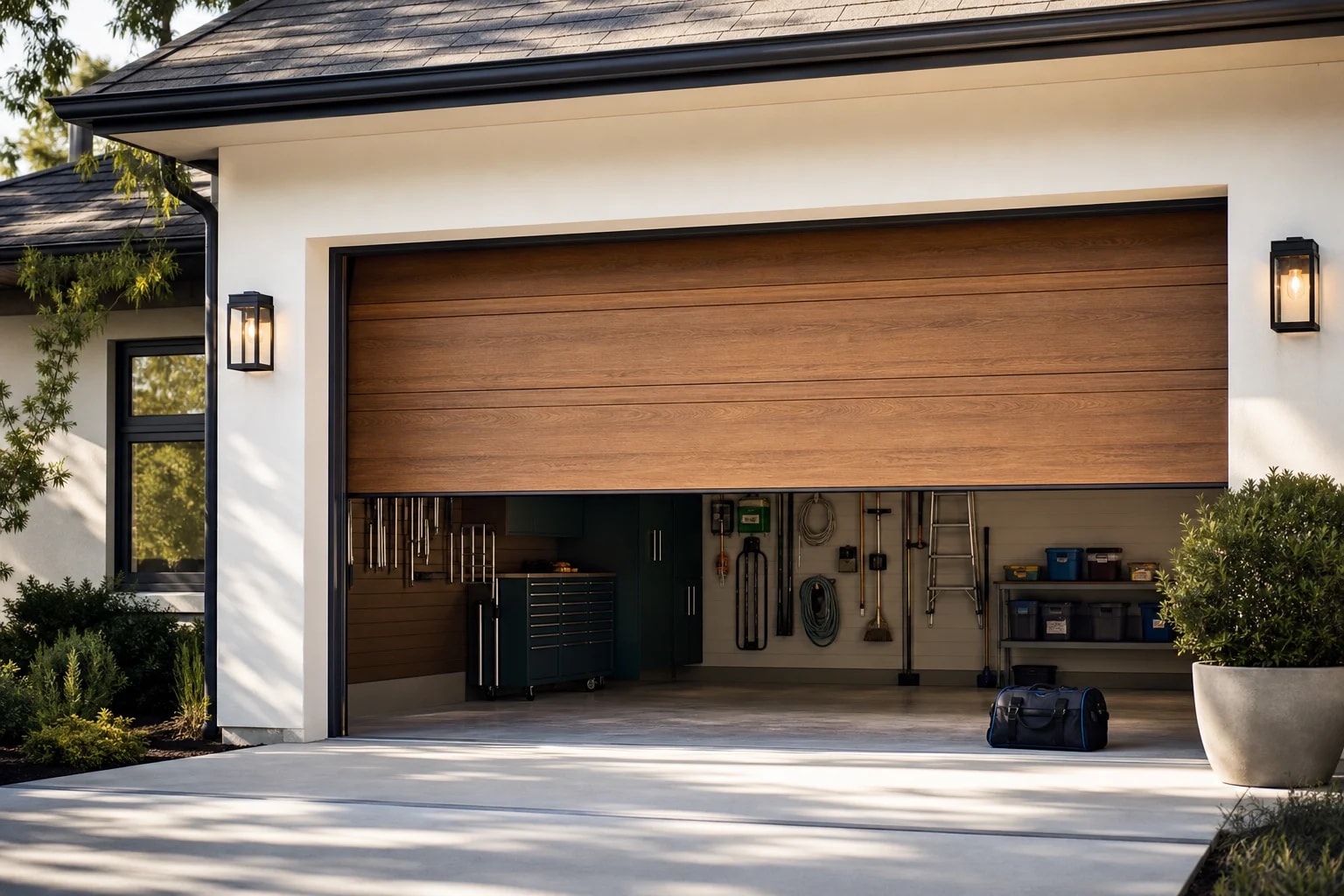
A garage door that will not close is one of the most frequent opener calls, and more often than not the door is doing exactly what it was designed to do. Every opener sold in the United States for decades has had to reverse if something is in the way, and the sensors that make that decision are easy to knock out of line.
This guide explains the difference between a door that reverses right away, one that reverses partway down, and one that will not start closing at all. Each points to a different cause. It also covers what you can look at from a safe distance, when to stop and call, and what a technician does.
What you notice
- You press the button and the door does not move, but the opener light flashes or clicks.
- The door starts down, stops after a few inches and goes back up.
- The door closes most of the way, touches the floor, then reverses and opens again.
- The door closes only when you hold the wall button down.
- The door closes but leaves a gap at the bottom, or slams the last foot.
- The door closes fine during the day but not at night, or not when the sun is low.
Likely causes
Safety sensors blocked, dirty or out of line
Two small sensors sit on either side of the door opening a few inches off the floor. If a broom, a bin, a cobweb or a bumped bracket breaks the beam, the opener refuses to close or reverses immediately and the light flashes. This is the single most common cause.
Sunlight on a sensor
Low direct sun can overwhelm the receiving sensor at certain times of day, which is why some doors only misbehave in the late afternoon.
Something in the door path
A rake handle, a car bumper a few inches too far forward, a stone under the bottom seal. If the door touches it, the force setting triggers a reverse.
Travel limits set wrong
The opener has an adjustable down limit. If it is set too far, the door hits the floor before the opener thinks it is done, reads that as an obstruction and reverses. A door that reverses at the floor usually has this problem.
Force setting too low or the door binding
If rollers, hinges or tracks are stiff, dry or bent, the door needs more effort to close than the opener is set to allow, so it reverses partway. Bumping the force up without fixing the binding is unsafe.
A sensor wire or sensor that has failed
Wires get pinched, chewed by rodents or corroded. When the opener cannot see the sensors at all, it closes only while the wall button is held, which is the built-in bypass.
A broken spring or a slipped cable
Less common for a door that will not close, but a cable off its drum can jam the door open at an angle. A crooked door is a stop-and-call situation.
Safe things to check before anyone comes out
- Look at the two sensors near the floor on each side of the opening without touching them. Each usually has a small light. A steady light on both normally means they see each other; a flickering or dark light on one means the beam is broken or the sensor is out of line.
- Look for anything crossing the beam: bins, boxes, a leaf pile, a cobweb, a bicycle wheel. Move loose items that are not touching the sensors or brackets.
- Check the door path for objects and look at the bottom seal for a stone or debris caught in it.
- Watch what the opener light does when you press the button once. Flashing with no movement almost always means sensors.
- Notice when it fails: only in bright sun, only at the floor, only partway down. Tell the technician; it narrows the cause.
- From a distance, confirm the door is level in the tracks and that no cable is hanging loose. If the door is crooked, stop here and call.
When to stop and call
- The door is crooked, hanging at an angle, or a cable is loose, dangling or broken. Keep people and cars away from it and do not press the opener button again.
- The door is stuck open and the home cannot be secured. Most companies treat this as a same-day visit.
- The door closes only when you hold the wall button. That means the safety sensors are not working and nobody should be in the opening while it moves.
- The door slams or drops the last foot. That is a spring or cable problem, not a sensor problem.
- You smell burning or see smoke at the opener.
What the technician does
- Checks the sensor lights, cleans the lenses and aligns the sensors so both indicator lights are steady, then tests that the door closes.
- Traces and repairs damaged or corroded sensor wiring, or replaces a failed sensor pair.
- Sets the down travel limit so the door seals at the floor without pressing into it, and sets the force to the lowest setting that closes the door reliably.
- Finds and fixes anything that makes the door bind: dry or worn rollers, loose hinges, bent track sections, a misaligned track.
- Checks the springs, cables and balance so the opener is not compensating for a heavy door.
- Runs the safety reversal test with an object under the door and explains how to test it yourself monthly.
What it usually costs
Realigning or cleaning the sensors and adjusting the limits is a short visit, usually in the low hundreds of dollars for the service call. Replacing a sensor pair or repairing wiring adds modestly to that. If the real cause is a binding door or a worn spring, the work and the price are closer to a spring or hardware job. The estimate should be explained before any work starts, including the trip fee.
What moves the estimate
- Whether the fix is an adjustment or a replaced part.
- Sensor wiring that has to be rerun along the wall or ceiling.
- Rollers, hinges or track sections replaced to stop the door binding.
- Springs or cables that are worn and replaced at the same visit.
- Time of day and urgency. Same-day and after-hours visits usually carry a higher rate.
Keeping it from coming back
- Keep the floor near the sensors clear and sweep that corner when you sweep the garage.
- Test the safety reversal monthly: with the door closing, a solid object like a short board laid flat in its path should make it reverse. If it does not, stop using the opener and call.
- Have the door balanced and the hardware lubricated about once a year so the opener is not fighting the door.
- Do not raise the force setting to make a stubborn door close. Fix the reason it is stubborn.
- If sunlight is the trigger, a technician can swap the sensors side to side or add a shade so the receiver is out of the sun.
Questions people ask
Why does the light flash when I press the button?
On most openers a flashing light with no movement is the code for a sensor problem: blocked, dirty, out of line, or not wired. Look at the sensor lights near the floor first.
Can I just hold the wall button to close it?
It works as a one-time bypass on most openers, but it means the safety sensors are not protecting anyone. Use it only with the opening in full view and nobody near it, and get the sensors fixed.
The door reverses when it touches the floor. Is that a sensor?
Usually not. That pattern is almost always the down limit set too far, so the opener presses into the floor and treats it as an obstruction. It is a quick adjustment, but check the sensors anyway.
Can I align the sensors myself?
Manufacturers describe it as a homeowner task, but it involves loosening brackets near the tracks and bottom of the door. If you are not comfortable, or the lights still will not go steady, it is a short visit for a technician.
Sources
- Chamberlain Group support: fix your garage door closing issues support.chamberlaingroup.com
- Chamberlain Group support: door travels a few inches then reverses support.chamberlaingroup.com
- DASMA: garage door opener safety tips (photo eyes and force settings) www.dasma.com
- Genie: garage door opener safety and reversal tests www.geniecompany.com