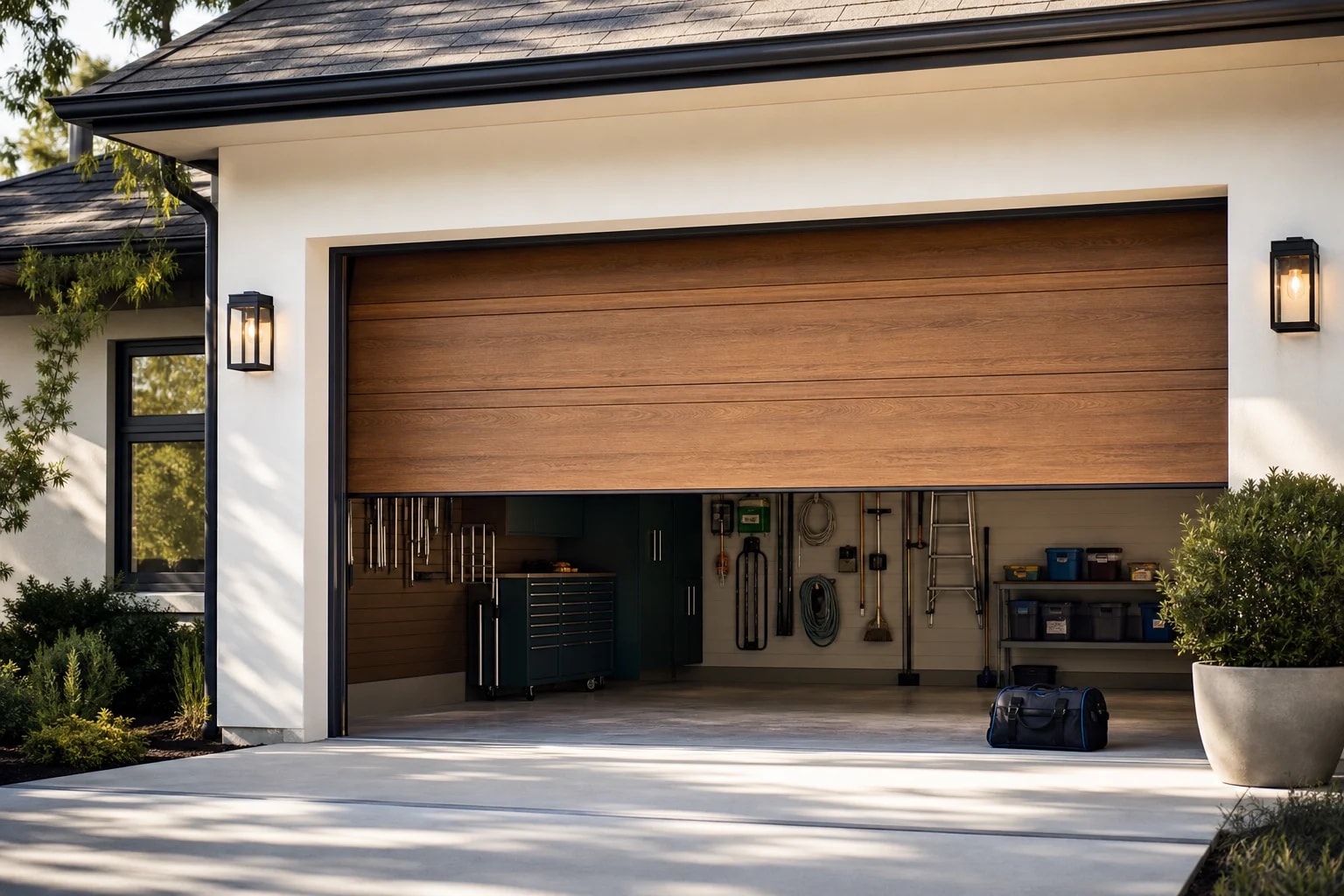
The opener is the motor unit on the ceiling, the rail it drives, the wall console, the remotes and the safety sensors. It does not lift the door; the springs do that. So an opener problem is usually about control and power, and the fix is often small, but it can also be the sign of a door that has become too heavy for it.
This guide sorts opener symptoms into the ones that point to the opener itself, the ones that point to the door, and the ones where a technician decides whether the unit is worth repairing. It stays clear of anything that involves opening the motor housing or touching the springs and cables.
What you notice
- Nothing happens from the remote or the wall button, and the opener light stays off.
- The motor runs and the trolley moves on the rail, but the door stays where it is.
- The opener grinds, clicks or hums and then stops.
- Remotes work from the driveway but not from inside the car, or only from a few feet away.
- The wall button works but no remote does, or a remote that was programmed stops responding.
- The door moves slowly, jerks, or the opener runs after the door has stopped.
- The opener light stays on, flickers or does not come on when the door moves.
Likely causes
No power
A tripped breaker, a GFCI outlet in the garage that has tripped, or the opener plug knocked loose. Nothing on the unit lights up.
Remote batteries, programming or interference
Weak batteries shorten range before they fail completely. A remote can also lose its code after a power surge, and some LED bulbs and nearby electronics interfere with the signal.
The door is disconnected from the trolley
Pulling the emergency release cord leaves the motor driving an empty rail. The door needs to be reconnected to the trolley, which is a simple step for a technician on a balanced door.
A stripped drive gear
Chain and belt openers have a plastic gear that wears out, especially when the door is heavy or out of balance. The motor hums, the gear spins, and plastic shavings may collect under the unit.
A failed logic board or capacitor
The circuit board controls the motor, remotes and sensors. Surges and age kill them. A capacitor failure often shows as a hum with no movement or a motor that starts only sometimes.
Travel or force settings drifting
The opener forgets or drifts its limits, so the door stops short, runs past, or reverses. On many units this follows a power cut.
The door itself has become too heavy
Worn springs, dry rollers and bent track make the door harder to move. The opener works harder, trips its safety limits, and eventually strips a gear or burns out. The opener is the victim, not the cause.
Safe things to check before anyone comes out
- See whether the opener light or any display lights up when you press the wall button. No light at all points to power.
- Look at other outlets in the garage. If a nearby outlet is dead too, a breaker or GFCI has tripped. Do not open the panel; just note it for the technician or reset a GFCI button if one is in reach.
- Try the wall button and each remote separately and note which work. Wall works, remotes do not: it is the remotes or the receiver. Nothing works: it is power or the opener.
- Look up at the rail from a safe spot. If the trolley moves and the door does not, the emergency release was pulled. Leave the door where it is.
- Look at the floor under the opener for plastic shavings, which usually mean a worn drive gear.
- Read the brand and model from the outside of the unit or the wall console if visible from the floor. Do not climb to find it.
- Confirm from a distance that the door is level in the tracks with no loose cable. A crooked door means stop and call.
When to stop and call
- The door is crooked, hanging at an angle, or a cable is loose, dangling or broken. Keep people and cars away from it and do not press the opener button again.
- The opener smokes, smells hot or sparks. Switch off the breaker if you can reach it without a ladder and call.
- The opener has no safety sensors near the floor. Openers without them are old enough that they should be replaced rather than repaired.
- The door will not close and the home cannot be secured, or a car is trapped inside.
- The door moves on its own or the opener runs with nobody pressing anything.
What the technician does
- Restores power if that is the issue and checks the outlet and the opener cord.
- Reprograms remotes and keypads, replaces batteries, and checks for interference from lighting or other electronics.
- Reconnects the door to the trolley and checks that the door is balanced before the opener is asked to move it.
- Replaces a stripped drive gear, a capacitor or the logic board where a repair makes sense for the age of the unit.
- Resets the travel limits and force settings and tests the safety reversal.
- If the unit is old, lacks safety sensors or needs more in parts than it is worth, explains the replacement options and what each includes.
What it usually costs
A service call to reprogram remotes, reconnect the door or reset limits is a short visit in the low hundreds of dollars. Replacing a gear, capacitor or board sits in a similar or slightly higher band depending on the part. A new opener installed is a larger job, typically several hundred dollars including the unit, more for belt-drive, wall-mount or smartphone-connected models. The estimate should be explained before any work starts, including the trip fee.
What moves the estimate
- Whether the fix is programming or a replaced part.
- The age and brand of the opener and whether parts are still available.
- Repair versus replacement, and the type of new opener if replacing.
- Work on the door itself, such as springs or rollers, that the opener problem uncovered.
- Time of day and urgency. Same-day and after-hours visits usually carry a higher rate.
Keeping it from coming back
- Keep the door balanced and its hardware serviced yearly. An opener on a balanced door can last well over a decade.
- Replace remote batteries on a schedule and keep a spare remote programmed.
- Plug the opener into a surge protector if the outlet allows it, especially where storms are common.
- Test the safety reversal monthly and have the sensors checked whenever they start flashing.
- Do not raise the force setting to overcome a stiff door. Fix the stiffness.
Questions people ask
Should I repair or replace my opener?
If it has safety sensors and the part is a gear, capacitor or remote, repair is usually sensible. If it is old enough to lack sensors, needs a logic board, or has had several repairs, replacement often costs little more and comes with a warranty.
Why do the remotes only work from close up?
Weak batteries first. Then interference from LED bulbs in the opener or nearby, or a damaged antenna wire on the unit. A technician can test range and swap the bulb or antenna.
The motor runs but the door does not move. Is the opener broken?
Often not. If the trolley moves, the door is just disconnected. If the trolley does not move while the motor runs, the drive gear is likely stripped. Both are routine repairs.
Can a new opener be installed on my old door?
Usually yes, as long as the door is in good condition and balanced. The technician checks the springs and hardware first, because a new opener on a heavy, unbalanced door will fail early too.
Sources
- DASMA: garage door opener safety tips www.dasma.com
- Chamberlain Group support: opener hums or clicks but the door does not move support.chamberlaingroup.com
- Genie: garage door opener safety features and checks www.geniecompany.com
- U.S. CPSC: openers without automatic reversal should be replaced www.cpsc.gov