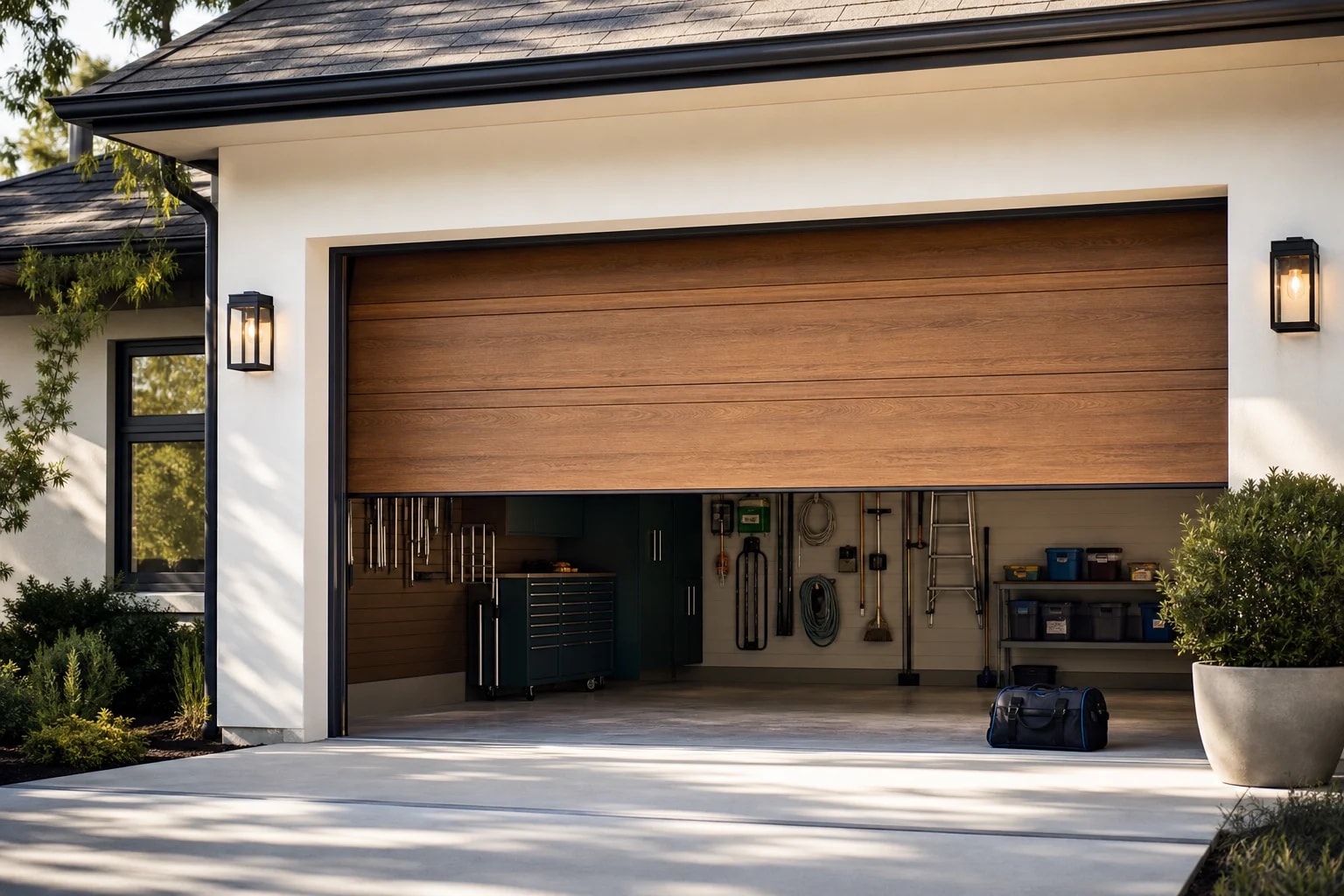
A garage door that will not open is usually one of two things: the opener is not getting the command, or the door itself is too heavy for the opener to lift because a spring has broken. The first is a nuisance. The second is a safety problem, and it is far more common than people expect.
Garage door springs and cables are under enormous tension. A torsion spring stores enough energy to lift a door that weighs several hundred pounds, and when one lets go it can injure or kill anyone nearby. Nothing on this page asks you to touch a spring, a cable, a track or the opener. It covers what you can see and hear from a safe distance, what it usually means, and what the technician does when they arrive.
What you notice
- You press the remote or wall button and nothing happens at all: no light, no sound.
- The opener light comes on and the motor hums or strains, but the door does not move.
- The door lifts a few inches, stops, and drops back down.
- You heard a loud bang from the garage, often at night, and the door has not opened since.
- The door opens unevenly, with one side higher than the other.
Likely causes
A broken torsion or extension spring
The most common reason a door suddenly will not open. The spring does the lifting; the opener only guides the door. When a spring breaks you often hear a bang like a firecracker, and afterwards the opener strains or lifts the door only a few inches. On a torsion spring above the door you may see a visible gap in the coil.
No power to the opener
A tripped breaker, an unplugged opener or a switched outlet in the garage. If the opener light does not come on and the wall button does nothing, this is the first thing a technician rules out.
A dead remote or the opener in lock mode
If the wall button opens the door but the remote does not, the problem is the remote or the lock button on the wall console, which disables remotes on purpose. Batteries are the usual cause.
The door is disconnected from the opener
The red emergency release cord disconnects the trolley from the door. If someone pulled it, the motor runs up and down the rail while the door stays put.
A frayed or slipped cable
Lift cables run from the bottom corners of the door to the drums above. If one slips off or breaks, the door jams at an angle in the tracks and will not move. This is a stop-and-call situation.
A manual lock, ice or an obstruction
An older door may have a slide lock that was engaged by hand. Ice bonding the bottom seal to the floor can also hold the door down.
A failed opener motor, gear or board
Openers wear out. A stripped drive gear, a burned-out motor or a failed circuit board shows up as humming, grinding or a dead unit with power present.
Safe things to check before anyone comes out
- Stand well back and look at the spring above the door, if the door has one. A gap of a couple of inches in an otherwise tight coil means the spring is broken. Do not touch it.
- Look at both sides of the door from a distance. Is it level in the tracks? Is any cable hanging loose, coiled on the floor or wrapped loosely around the drum at the top? If so, keep everyone away and stop here.
- Check whether the opener light comes on when you press the wall button. No light usually means a power problem; light with no movement usually means a mechanical one.
- Listen when you press the button once. A hum or strain with no movement points to the door being too heavy for the opener, most often a broken spring. Do not keep pressing; each try strains the opener.
- Look at the wall console for a blinking light or a lock indicator, and try a different remote if you have one.
- Look at the rail above the door. If the trolley moves along the rail but the door stays still, the emergency release was pulled. Leave it that way for the technician.
When to stop and call
- The door is crooked, hanging at an angle, or a cable is loose, dangling or broken. Keep people and cars away from it and do not press the opener button again.
- You heard a bang and can see a gap in the spring. The door is now far heavier than it looks and should not be lifted by hand.
- The door is partway open and will not move either way. Do not try to push it up or pull it down.
- The opener smells hot, smokes or sparks. Switch off the breaker if you can reach it without a ladder and call.
What the technician does
- Looks at the door, springs, cables, drums and tracks before touching anything, and confirms what is broken and whether the door is safe to move.
- If a spring is broken, replaces it with the correct size for the door weight, and usually recommends replacing both springs on a two-spring door so they wear evenly.
- Rewinds or replaces lift cables, reseats them on the drums and resets the door level in the tracks.
- Balances the door so it stays put when lifted halfway by hand with the opener disconnected. A balanced door is what keeps the opener from being overworked.
- Checks the opener: power, the drive gear, the travel and force settings, the remotes and the wall console.
- Tests the safety reversal with an object under the door, lubricates the moving parts, and explains what caused the failure and what to watch for.
What it usually costs
A service call to diagnose and fix a minor problem, such as a remote, a lock setting or a reconnected trolley, usually runs in the low hundreds of dollars. Replacing a spring or a pair of springs with the visit is commonly a few hundred dollars, more for large or heavy doors. A new opener is a larger job in the several-hundred-dollar range plus the unit. The estimate should be explained before any work starts, including the trip or diagnostic fee.
What moves the estimate
- Whether a spring broke and whether one or both are replaced.
- Door size and weight: a double insulated door needs heavier springs than a single steel door.
- Cables, rollers or drums that are worn and replaced at the same visit.
- Whether the opener can be repaired or needs replacing.
- Time of day and urgency. Same-day and after-hours visits usually carry a higher rate.
Keeping it from coming back
- Have the door balanced and the springs, cables and rollers inspected about once a year, before anything fails.
- Listen for new sounds. A door that gets louder or jerkier over a few weeks is telling you something is wearing.
- Replace remote batteries yearly so a dead remote is never mistaken for a dead opener.
- If one spring breaks on a two-spring door, replace both. The second one is usually close behind.
Questions people ask
Can I open the door by hand with the emergency release?
Only if the springs and cables are intact and the door is level. With a broken spring the door can weigh hundreds of pounds and can drop on you. If you are not sure the spring is fine, leave the door alone and let the technician open it.
Why does the opener hum but nothing moves?
The motor is working against something it cannot lift. The usual causes are a broken spring, a stripped drive gear inside the opener, a locked door or a trolley that is stuck. All of them are fixed on a normal visit.
Is it the opener or the door?
A rule of thumb: if the wall button does nothing and the light stays off, suspect power or the opener. If the opener runs and strains, suspect the door, most often a spring. The technician checks both either way.
Sources
- DASMA: Garage door systems safety tips (springs and cables) www.dasma.com
- Chamberlain Group support: what to do when your garage door makes noises but does not move support.chamberlaingroup.com
- Genie: garage door opener safety and monthly checks www.geniecompany.com
- U.S. CPSC: garage door opener child-entrapment safety program www.cpsc.gov