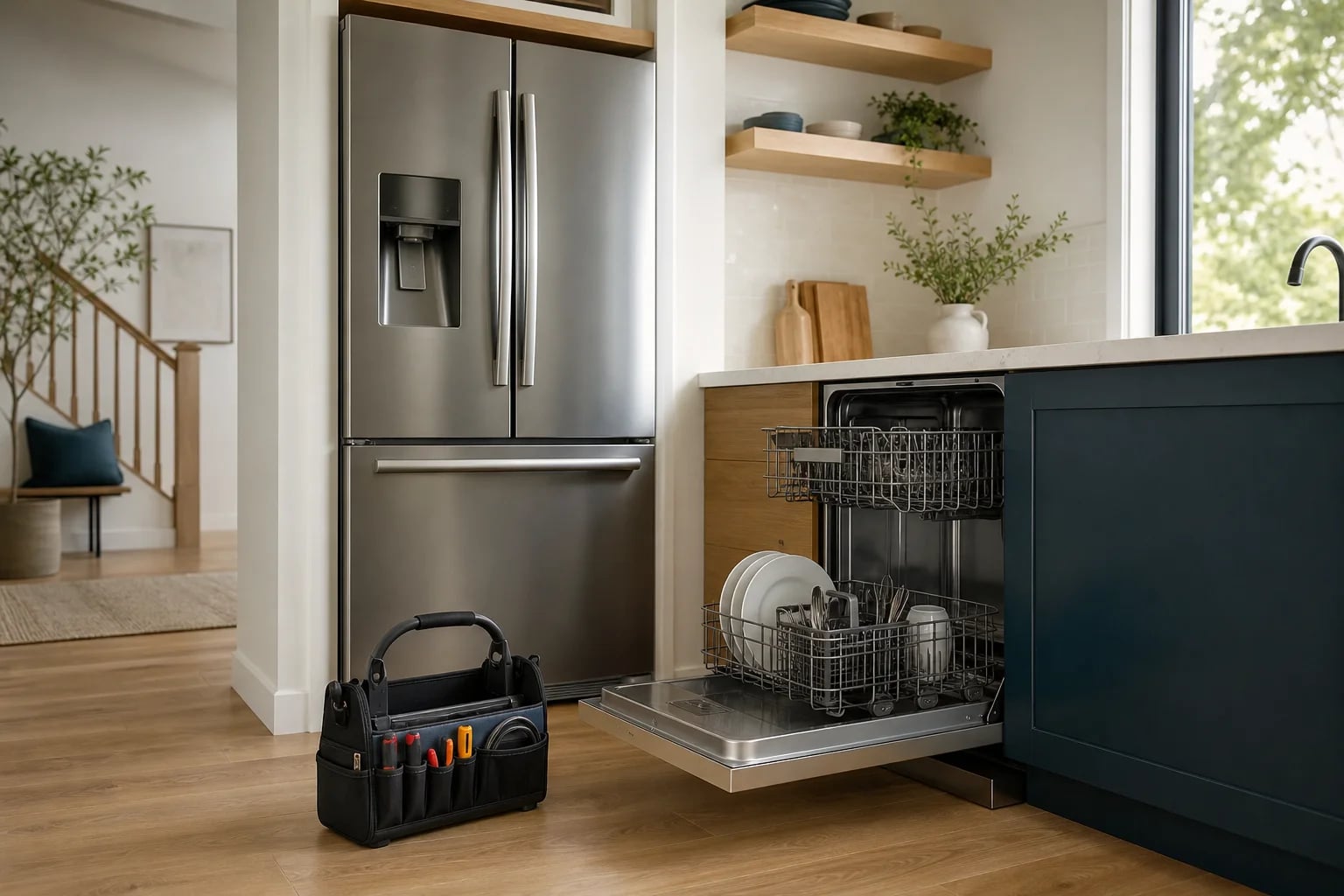
Dishwashers sit at an awkward price point. They cost less than a refrigerator or a washer, which means a repair does not have to be very expensive before it rivals a new machine, and they are built into cabinetry, which means replacing one is more than carrying a box in from the driveway.
That combination makes the repair-or-replace question come up often, and the answer depends on the part. Some dishwasher failures are quick and cheap; a few are not worth doing on anything but a nearly new machine. This article covers typical service life, what is worth repairing, what usually is not, the fifty-percent rule of thumb, and what a technician should tell you before you decide.
Typical service life
Virginia Cooperative Extension puts a dishwasher’s useful life at about ten years. That is a typical figure, not a limit. Machines that run once a day with soft water often go longer; machines in hard-water homes with heavy use may need major work sooner.
Age matters for two reasons beyond wear. Dishwasher technology has changed quickly, so a machine from a decade ago is louder and uses more water and energy than a current one. And parts for older models thin out, so the repair you want may not be possible at any price. The manufacturing date is on the label inside the door edge.
Repairs that are usually worth it
These are the common calls, and most are resolved in a single visit with a modest part.
- Drain pump or a clogged drain path. Standing water in the bottom at the end of a cycle is the most common complaint and often ends with a piece of glass or a food label in the pump.
- Water inlet valve when the machine fills slowly or not at all.
- Door latch or door switch when it will not start, or the door spring and cable when the door drops open.
- Heating element when dishes come out wet and cold, on models where the element is accessible and reasonably priced.
- Spray arms, wash arm supports, and the filter assembly. Poor cleaning is often a maintenance issue, not a failure.
- A leaking door gasket. Cheap, and it stops a leak that would otherwise ruin the floor.
Repairs that usually are not
Because the machine itself is moderately priced, the list of repairs that do not pencil out is longer than for a refrigerator.
- Circulation pump and motor assembly on an older unit. The wash motor is the heart of the machine and on many models the part alone is a large share of a replacement.
- A cracked tub or a tub that is rusting at the rack tracks. Not realistically repairable.
- Main control board when the board is expensive or discontinued. Price it first; sometimes it is fine.
- A leak from the sump or tub seals that has already damaged the floor or cabinet. Fix the leak source, but a machine that has been weeping for months often has more wrong than the seal.
- Several moderate repairs needed at once on a machine near or past ten years.
The fifty-percent rule of thumb
The usual guideline: if a repair costs more than about half of a comparable new dishwasher and the machine is past the midpoint of its expected life, replacement is usually the better value. It is a rule of thumb, and the dishwasher is where it bites hardest, because the replacement side of the comparison is relatively low.
Adjust it for your situation. A panel-ready or unusual-size machine raises the real cost of replacement, which makes a bigger repair more reasonable; a standard machine in a standard opening lowers it. Include installation and haul-away on the replacement side so the comparison is fair.
Efficiency and rebates
ENERGY STAR notes that dishwasher technology has improved substantially over the last decade, and current certified models use less water and energy per cycle than older machines. For most households the yearly saving is small in dollars but it does add up, and newer machines are also quieter, which many people value more than the utility bill.
Rebates for ENERGY STAR dishwashers are offered by some utilities and water agencies and change year to year. Check the ENERGY STAR rebate finder and your utility when you are ready to buy.
What a technician’s estimate should tell you
Before you approve a dishwasher repair, make sure the estimate covers these points.
- The failed part and how it was confirmed. Many dishwasher symptoms have several possible causes; a drain problem could be the pump, a check valve, a clogged hose or the garbage disposal connection.
- Whether the machine has to come out from under the counter. That adds time and can affect flooring and plumbing connections.
- Parts and labor separately, the diagnostic fee, and whether it is credited to the repair.
- The age of the machine and warranty status of the failed part.
- The warranty on the repair.
- Any signs of water damage under or around the machine, which can change the decision entirely.
What to do while you decide
If the dishwasher is leaking, turn off its water supply valve under the sink and stop using it. Check the simple things: the filter at the bottom of the tub is clean, the spray arms spin freely, the drain hose is not kinked, and the disposal knockout plug was removed if the disposal is new. Bail out standing water with a cup and note the model, serial number and any error code. Hand-washing is a fine stopgap; there is no need to decide the same day unless water is reaching the floor.
Questions people ask
My dishwasher leaves dishes dirty. Is that a repair?
Often not. Clean the filter and spray arms, check water temperature at the sink, and use a rinse aid before calling anyone. If cleaning does not help, a weak circulation pump or a failed heating element may be the cause, and the pump in particular can tip the decision toward replacement on an older machine.
Is a dishwasher that will not drain worth repairing?
Usually, yes. The cause is often debris in the pump, a clogged hose or a failed drain pump, all of which are modest repairs.
My dishwasher is eight years old. Repair or replace?
For a small repair, repair. For a wash motor, control board or tub problem, get the quote and compare it to a new machine installed; at eight years the fifty-percent rule usually points to replacement for those.
Should I worry about a slow leak?
Yes. Water under a dishwasher damages the subfloor and cabinets quietly for months. Find the source promptly even if the leak seems small.
Sources
- ENERGY STAR: Dishwashers (efficiency and features) www.energystar.gov
- Virginia Cooperative Extension: What about Appliances? (typical dishwasher life) ext.vt.edu
- GE Appliances: Owner support (manuals, date codes, warranty) www.geappliances.com