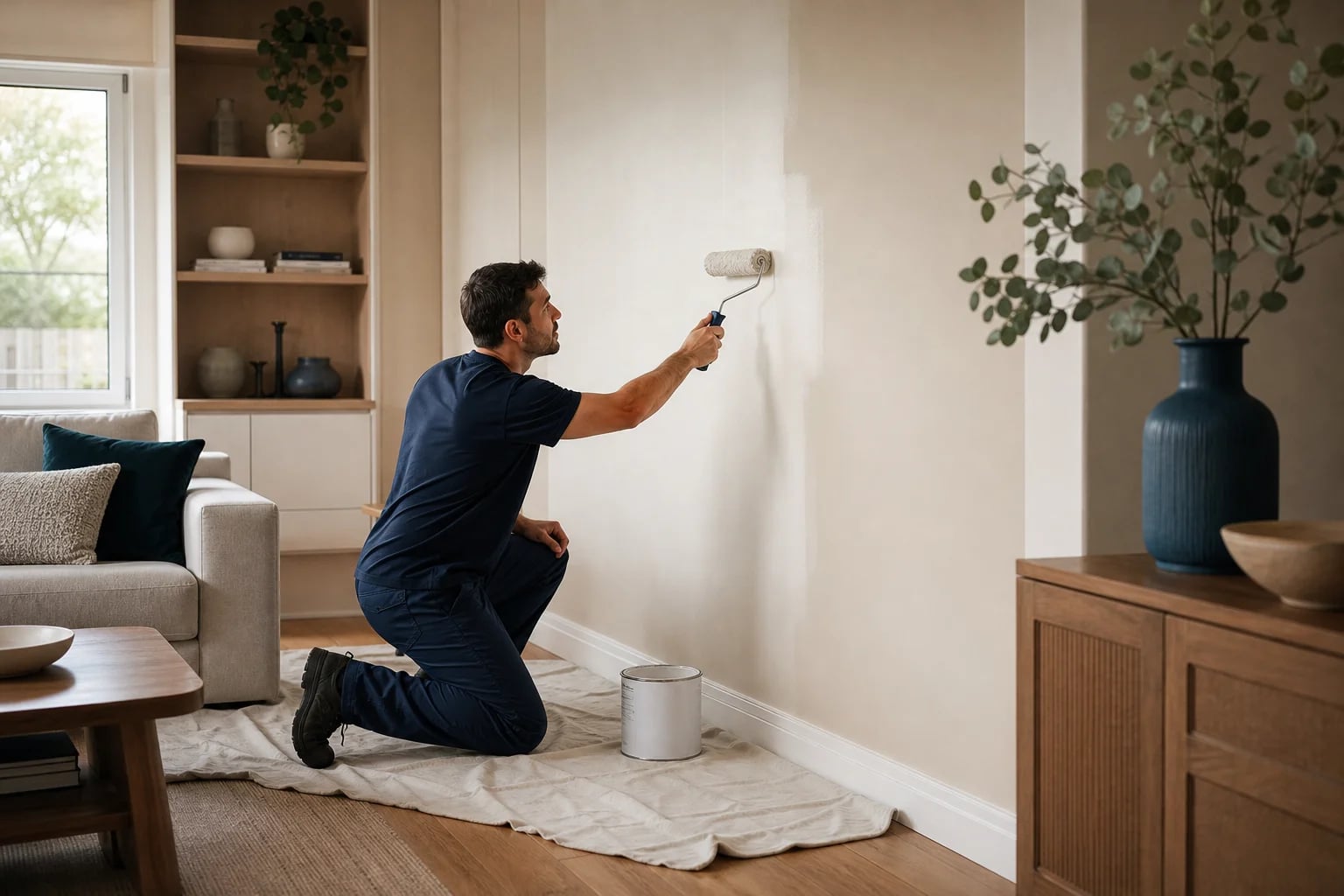
Painting looks like the easiest trade to hire for, which is why it is so often hired badly. The paint is the cheap part; what you are paying for is preparation, and preparation is exactly what a rushed crew skips. Peeling a year later, visible roller marks, drips on the trim and patched drywall that shows through in raking light are the usual results.
This guide covers the credentials that matter for painters and drywall contractors, including the federal lead-safe certification that applies to older homes, the questions that reveal how much prep is in the price, the red flags, how to compare bids on the same rooms, and what to expect on the day.
Licenses, insurance and permits
EPA Lead-Safe Certified Firm (pre-1978 homes)
Under the EPA Renovation, Repair and Painting rule, any business paid to disturb painted surfaces in a home or child-care facility built before 1978 must be an EPA-certified firm, use certified renovators and follow lead-safe work practices. That includes sanding, scraping and most drywall repair. Ask for the firm’s certificate and look it up in the EPA database.
State or local contractor license
Rules vary widely. Some states license painting contractors above a dollar threshold; others, like Florida at the state level, do not license painters as a trade, though a local business tax receipt is usually required. Drywall work that is structural or part of a larger renovation may fall under a general contractor license. Check your state’s rules and ask what the business holds.
General liability insurance
Paint on the hardwood, a ladder through a window, overspray on the neighbor’s car: liability insurance is what pays for it. Ask for a certificate in the business name with current dates.
Workers’ compensation
Painters work on ladders, scaffolds and lifts. A business with employees should carry workers’ compensation so an injury at your home is covered by the employer, not you.
Industry standards
The Painting Contractors Association publishes industry standards that define what a properly finished surface looks like and how a touch-up should be judged. A contractor who works to a named standard has something to be held to; ask whether the estimate references one.
Questions to ask
- Was my home built before 1978, and if so, are you an EPA Lead-Safe Certified Firm? Can I see the certificate?
- Will you give me a written estimate before any work, listing each room or surface, the prep steps, the number of coats and the products by name?
- What preparation is included: washing, scraping, sanding, filling nail holes, caulking, priming bare spots, and repairing drywall?
- How do you protect floors, furniture, fixtures and landscaping from drips and overspray?
- How many coats are in the price, and what happens if a dark color needs a third?
- What is your warranty on the workmanship, in years, and what does it exclude?
- What is the payment schedule, and is the final payment due only after I have inspected in daylight?
- Can you give me two recent customers with a similar job I can call?
Red flags
- Quotes a price from the doorway, or by the square foot, without looking at the condition of the walls, trim and ceilings.
- No written estimate, or one that says "paint interior" with no prep, coats, products or rooms listed.
- Full payment up front, or cash only. A deposit toward paint on a large job is normal; paying for labor you have not received is not.
- On a pre-1978 home, dismisses lead rules, cannot produce an EPA firm certificate, or plans to dry-sand or power-wash old paint.
- Knocks on the door saying the crew has leftover paint from a job nearby and can do your house cheaply today.
- Vague about insurance, or pressures you to decide today.
- Will not name the paint line, or plans to supply "contractor grade" without saying what that is.
Comparing quotes fairly
- Compare the prep before the price. The biggest difference between a cheap bid and a good one is usually washing, sanding, caulking and priming that the cheap bid left out.
- Count the coats and name the product. One coat of a premium line and two coats of a builder-grade line are not the same job, and neither matches a bid that does not say.
- Make sure every bid covers the same surfaces: walls only, or walls, ceilings, trim, doors and closets. Trim and doors are slow work and change the number a lot.
- Weigh the warranty and insurance as part of the value. A low bid with no coverage and no workmanship warranty is lower because the risk has moved to you.
- Give an edge to the painter who looked closely: ran a hand over the walls, checked the trim for failed caulk, asked about water stains. That is the person who priced the real job.
On the day
- Walk the job with the lead painter before anything is opened. Confirm the written estimate, the colors and sheens by name, and which surfaces are included.
- Move small furniture, electronics, art and anything on the walls out of the rooms; the crew usually moves large pieces to the center and covers them.
- In a pre-1978 home, expect plastic sheeting, sealed doorways, a HEPA vacuum and warning signs. That is lead-safe work practice doing its job, not overkill.
- Keep pets and children out of the work area, and plan for the smell and ventilation; low-odor products help but do not eliminate it.
- Inspect in daylight before the final payment, from the angle light hits the wall: cut lines, trim edges, coverage on dark-to-light changes, any patches. Mark touch-ups with tape and keep the leftover labeled paint.
Questions people ask
Does the lead rule really apply to a one-room job?
If the home or child-care facility was built before 1978 and a paid contractor disturbs painted surfaces beyond very small areas, yes. The rule is federal, and the contractor, not you, is the one who must be certified. Homeowners doing their own work are generally exempt, but the dust is just as hazardous.
Should I buy the paint myself?
You can. Most painters prefer to supply it: they get contractor pricing, they know the line, and the workmanship warranty is cleaner when they chose the material. If you supply it, agree in writing on the product and quantity.
How many coats should I expect?
Two finish coats over suitable primer is the usual standard for a good result; one coat is a refresh of the same color on a sound surface. Dark or very saturated colors, and painting over a dark color, can need more. The written estimate should say how many are included.
What is a fair deposit?
For a small interior job, none or a small amount toward paint; for a large exterior, a modest deposit when materials are ordered with the balance after you inspect. Full payment up front is a red flag in this trade as in every other.