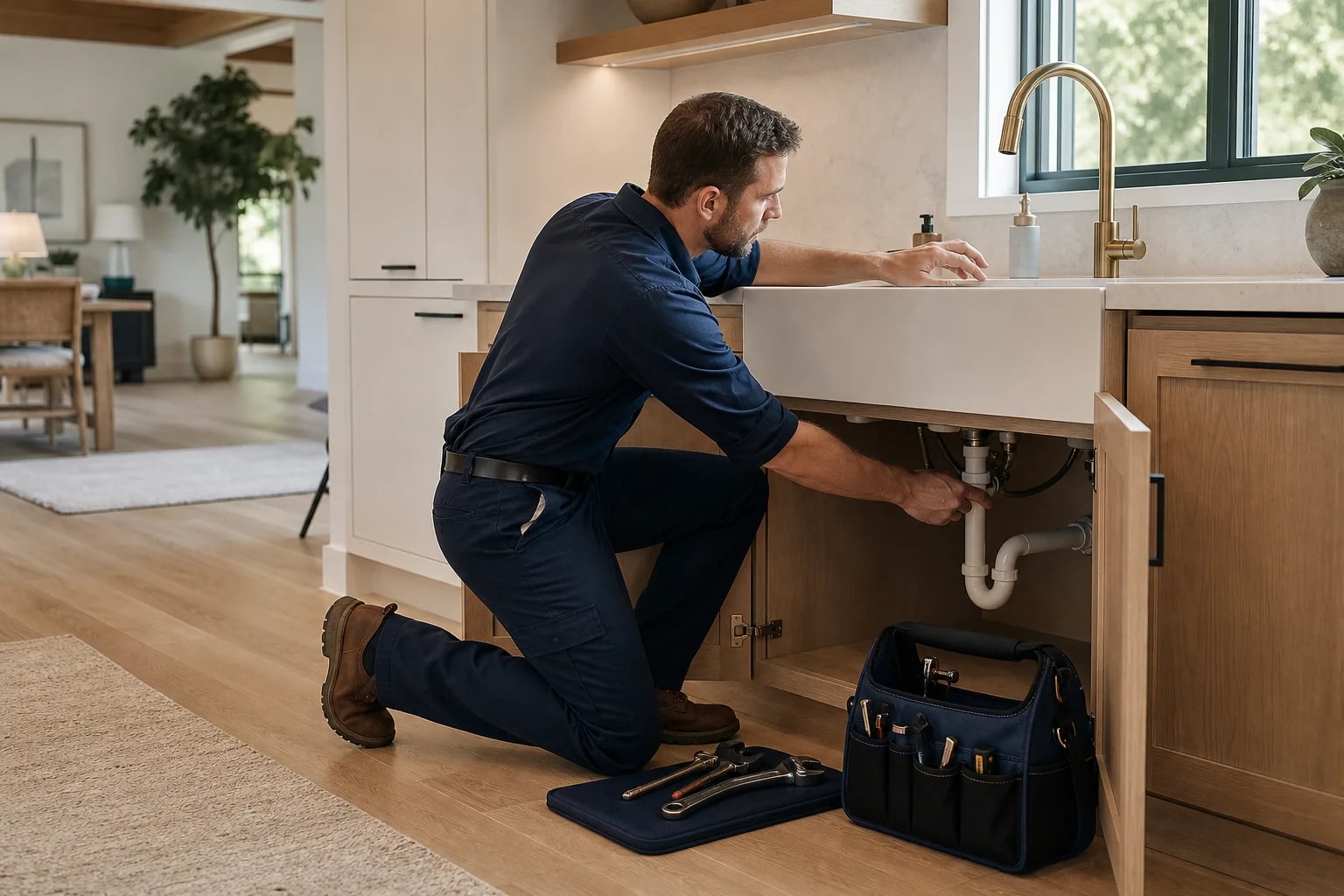
Most plumbing calls start in a hurry: a leak under the sink, a drain that stopped, a water heater that gave out on a Sunday. That is exactly when it is easiest to hire the first name that answers the phone. A few minutes of checking before you book saves far more than it costs.
This guide covers what credentials a plumbing business should be able to show, what to ask before anyone comes out, the warning signs that should end the conversation, and how to compare two or three estimates without simply picking the lowest number.
It is general advice. Licensing and permit rules differ by state and sometimes by county or city, so treat the examples here as a starting point and check the rules where you live.
Licenses, insurance and permits
State plumbing contractor license
In most states, a business that does plumbing work for pay must hold a contractor license, and the person doing the work must be licensed or working under someone who is. The license type matters: a handyman registration is not a plumbing license. Rules vary by state. In Florida, for example, plumbing contractors are licensed through the Construction Industry Licensing Board, and anyone can look up a license by name or number on the DBPR Verify a Licensee page. Ask for the license number, then check it yourself.
General liability insurance
Covers damage to your home if a fitting fails or a wall is opened in the wrong place. Ask for a certificate of insurance naming the business, and check the dates.
Workers’ compensation
If a technician is hurt on your property and the business has no coverage, the claim can land on you. Sole proprietors are sometimes exempt from carrying it, which is worth knowing; ask how the people who will be in your home are covered.
Permits
Water heater replacement, repiping, moving a drain, adding a fixture and sewer line work usually need a permit and an inspection. Clearing a clog or replacing a faucet usually does not. The business pulls the permit under its own license. A request that you pull it as the homeowner is a sign the business may not be able to.
Manufacturer authorizations and endorsements
For a tankless water heater or a water softener, some makers list authorized installers and the warranty may depend on using one. Gas line and backflow work often need a separate certification. Ask when the job touches any of these.
Questions to ask
- What is your license number, and who holds the license: the business, or a person who will be on the job?
- Do you charge a trip or diagnostic fee, and does it go toward the repair if I go ahead?
- Will I get a written estimate before any work starts, and what happens if you find something else once you open the wall?
- Is the work covered by a warranty on labor as well as parts, and for how long?
- Will this job need a permit? Who pulls it and who meets the inspector?
- Who will actually come to the house: an employee, an apprentice under supervision, or a subcontractor?
- What do you need me to do before you arrive: clear the cabinet, find the shutoff, move the car?
Red flags
- Cash only, or a discount for cash with no receipt. Reputable businesses take cards and checks and give you paper.
- No written estimate, or an estimate that only appears after the work is done.
- A knock on the door from someone who was working in the area and noticed a problem with your plumbing from the street. Plumbing problems are not visible from the street.
- Full payment up front. A deposit for a large job with ordered parts is normal; paying everything before anyone has touched a pipe is not.
- Scare tactics: the house will flood tonight, the whole system has to be replaced today. Real emergencies exist, but a competent plumber explains them calmly and shows you why.
- A license number that does not come up in the state lookup, or comes up under a different name or trade.
Comparing quotes fairly
- Compare the same job. One estimate may include a new shutoff valve, a permit and haul-away while another quietly leaves them out. Line them up item by item before looking at the totals.
- Check what the warranty covers and for how long. A labor warranty from a licensed business with an address is worth something; a lifetime guarantee from a business with no address is not.
- Look at how each plumber found the problem. The one who ran water, checked the second fixture and explained the cause is more likely to fix it once.
- Note the diagnostic or trip fee and whether it is credited to the job. It changes the real cost of the lower quote.
- Discard any quote that was not written down. A number over the phone before anyone has looked at the problem is a guess, not an estimate.
On the day
- Clear the area: empty the cabinet under the sink, move boxes away from the water heater, clear a path to the cleanout or crawl space.
- Know where your main water shutoff is and tell the plumber. It saves time if something goes wrong mid-repair.
- Expect the plumber to confirm the problem, explain the cause and present the written estimate before work starts. If the plan changes once a wall is open, they should stop and get your approval again.
- Ask to see the old part when something is replaced, and ask them to run every affected fixture before they leave.
- Get an itemized invoice that matches the estimate, with the license number on it, and pay by a method that leaves a record.
Questions people ask
Does a plumber need to be licensed for a small job like a faucet?
In most states the business doing plumbing for pay needs a license regardless of job size, even when no permit is required. The size of the job does not change who is allowed to do it. Check your state’s rules.
Can I pull the permit myself to save money?
Many jurisdictions let an owner-occupant pull a permit for their own home, but then you are the one responsible for the work and the inspection. If a business asks you to pull the permit for work they are doing, it usually means they cannot pull it themselves.
Is a big company safer than a one-person shop?
Not necessarily. What matters is the license, the insurance, the written estimate and how they handle problems. A one-person licensed shop with good references can be a better choice than a large outfit with high-pressure sales.
What if the plumber finds more problems once they start?
That happens, especially in older homes. A good plumber stops, shows you what they found, and gives you a revised written estimate before continuing. You can say no to the extra work.
Sources
- FTC Consumer Advice: How to avoid a home improvement scam consumer.ftc.gov
- Florida DBPR: Construction Industry Licensing Board (plumbing contractors) www2.myfloridalicense.com
- Florida DBPR: Verify a licensee (license search) www.myfloridalicense.com
- Plumbing-Heating-Cooling Contractors Association (PHCC) www.phccweb.org