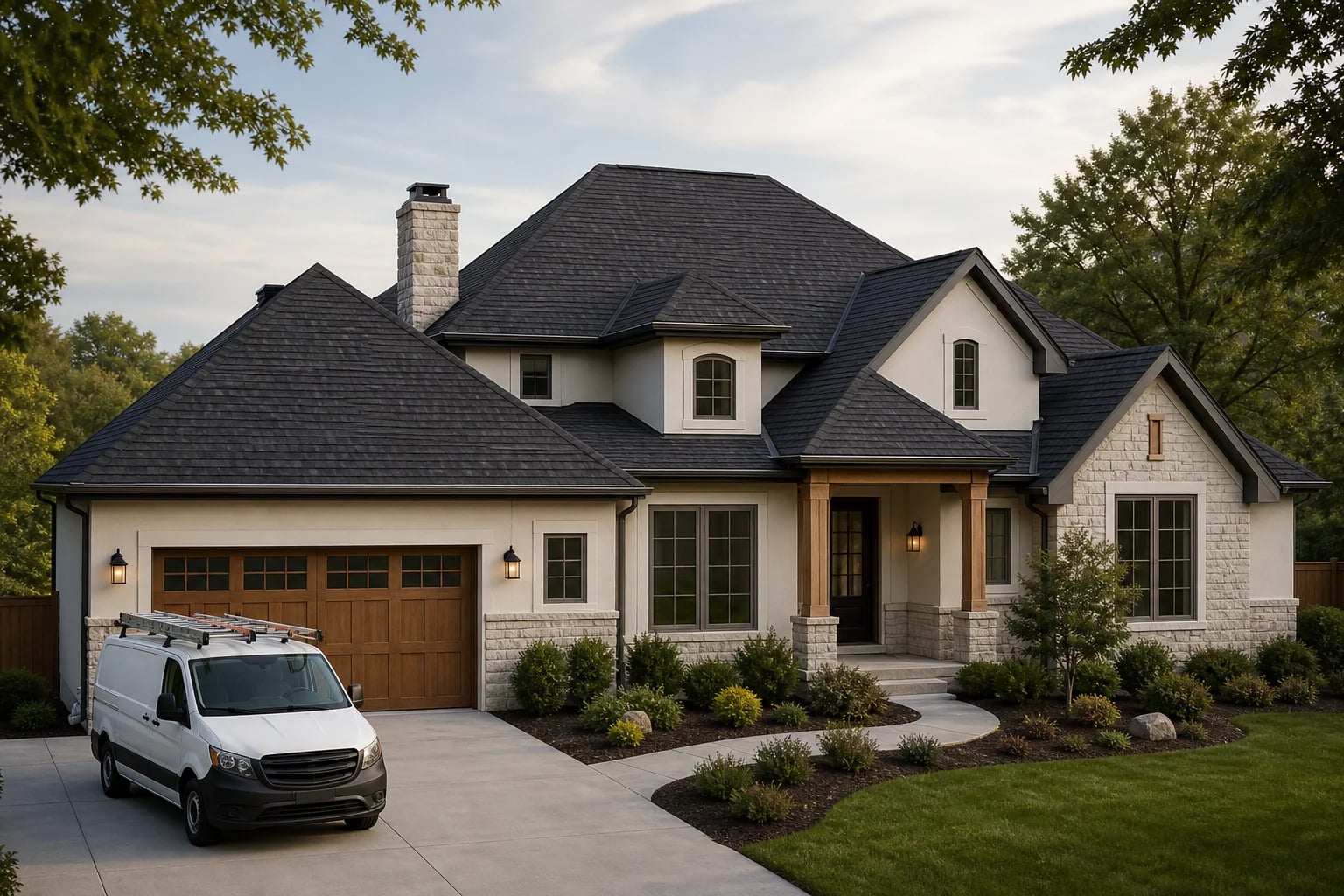
Atlantic hurricane season runs from June through November, and the Gulf and Atlantic coasts see most of the storms that make landfall in the United States. The homes that come through a storm with the least damage are usually the ones where somebody walked the property in May, found the weak spots, and had them fixed while contractors still had open calendars.
This checklist is organized the way a storm tests a house: the roof, the garage door, the power you will rely on when the grid goes down, and the appliances you will switch back on afterward. Everything here can be done from the ground; the parts that need a ladder, a roof or a wiring panel are called out as jobs for a professional.
Roof and gutters: look from the ground, let a roofer go up
The roof is the first thing wind works on. Loose shingles, cracked sealant around vents and flashing, and gutters pulling away from the fascia all become entry points once rain is blowing sideways. The National Roofing Contractors Association recommends inspecting a roof twice a year and after any severe weather, and it is clear that a homeowner's inspection should be done from the ground. Falls are the main hazard in roof work, and binoculars show you almost everything you need to know.
A roofer will walk the roof, re-seal or replace lifted shingles, check flashing at chimneys and vents, confirm the ridge and edge are fastened, and tell you whether the roof is a candidate for roof-to-wall strapping or replacement with wind-rated materials. Ask for photos of anything they repair.
- From the yard, scan every slope for shingles that look curled, lifted or missing, and for dark patches where granules have washed off.
- Look at the gutters along their whole length. Sagging sections, gaps at the seams and brackets pulled out of the fascia all need a hand before the wind gets to them.
- Look at the soffit (the underside of the eave) for loose or missing panels. Wind pries open soffits and then pushes rain into the attic.
Garage door: the largest opening in the house
FEMA describes the garage door as the largest potential breach point of a house. If it fails under wind pressure, the garage fills with air, and that pressure can lift the roof or push out walls from inside. Double-wide doors are the most vulnerable because they flex so much across their width.
The fix is reinforcement: horizontal bracing (girts) on the back of each panel, heavier hinges and end supports, and stronger tracks. Older or lightly built doors are often better replaced with a door rated for your local design wind speed. This is a garage door company's job; springs and tracks are under tension and should never be adjusted by a homeowner. While you are outside, follow FEMA's other advice: secure or bring in anything loose, have a tree service remove dead limbs within reach of the house, and call the utility about limbs near the lines.
- Look at the inside of the door. Factory-reinforced doors have horizontal struts across the panels; a door with nothing but thin panels and a few hinges is a candidate for a bracing kit.
- Look for a wind-load label on the door or in the manufacturer's paperwork. If there is none, assume the door is unrated.
- Ask the garage door company whether a bracing kit is available for your model and whether the tracks and jambs can take the extra load.
Generator safety: the rules that are not optional
Carbon monoxide from portable generators kills people every hurricane season, often in the days after the storm when the weather is calm and the house is dark. The U.S. Consumer Product Safety Commission's guidance is blunt: run a generator outdoors only, at least 20 feet from the house, with the exhaust pointed away from windows, doors and vents. Never in a garage, carport, porch, basement or crawl space, even with the door open.
The other serious risk is backfeed. Plugging a generator into a wall outlet can send power back through the utility lines and injure a line worker. Either plug appliances directly into the generator with outdoor-rated cords, or have an electrician install a transfer switch or interlock so the generator powers the house safely. Do not open the electrical panel yourself.
- Install battery-powered or battery-backup CO alarms on every level and outside sleeping areas, and test them before the season.
- Ask an electrician about a transfer switch or interlock kit now. It cannot be done during the storm.
Appliances and HVAC after the power comes back
Power rarely comes back cleanly after a storm. Surges and brownouts in the first hours are hard on compressors and control boards, so FEMA's advice is to unplug appliances during the outage and plug them back in once power is stable. Anything that sat in standing water, including the outdoor AC unit, should be inspected by a qualified technician before it is turned on.
- Before the storm: unplug TVs, computers and small appliances, and turn the thermostat off so the AC does not try to restart on unstable power.
- After the storm: wait until lights are steady before turning the AC back on. If the outdoor unit sat in water or has debris in it, call an HVAC technician before running it.
- Check the refrigerator and freezer against the four-hour rule. See the power outage checklist on this site for the details.
- Walk the property for downed lines before anything else. Treat every line as live and call the utility.
Questions people ask
When should I start this checklist?
Late spring is ideal. The season starts June 1, and the busiest months are August through October. Roofers and garage door companies are much easier to book in April and May than in the week before a named storm.
Can I check the roof myself with a ladder?
The roofing industry's own advice is to inspect from the ground. Binoculars show lifted shingles and sagging gutters well enough to decide whether to call someone, and the fall risk is not worth the few details a ladder adds.
What is the one thing people get wrong with generators?
Running them too close to the house. A generator in a garage with the door open, or on a covered porch, still fills the house with carbon monoxide. Twenty feet from the house, exhaust pointed away, and CO alarms inside.
Sources
- Ready.gov (FEMA): Hurricanes www.ready.gov
- National Weather Service: Hurricane safety tips and resources www.weather.gov
- FEMA: Protect your property from severe winds (brochure, 2023) www.fema.gov
- U.S. CPSC: Generators and engine-driven tools (carbon monoxide safety) www.cpsc.gov