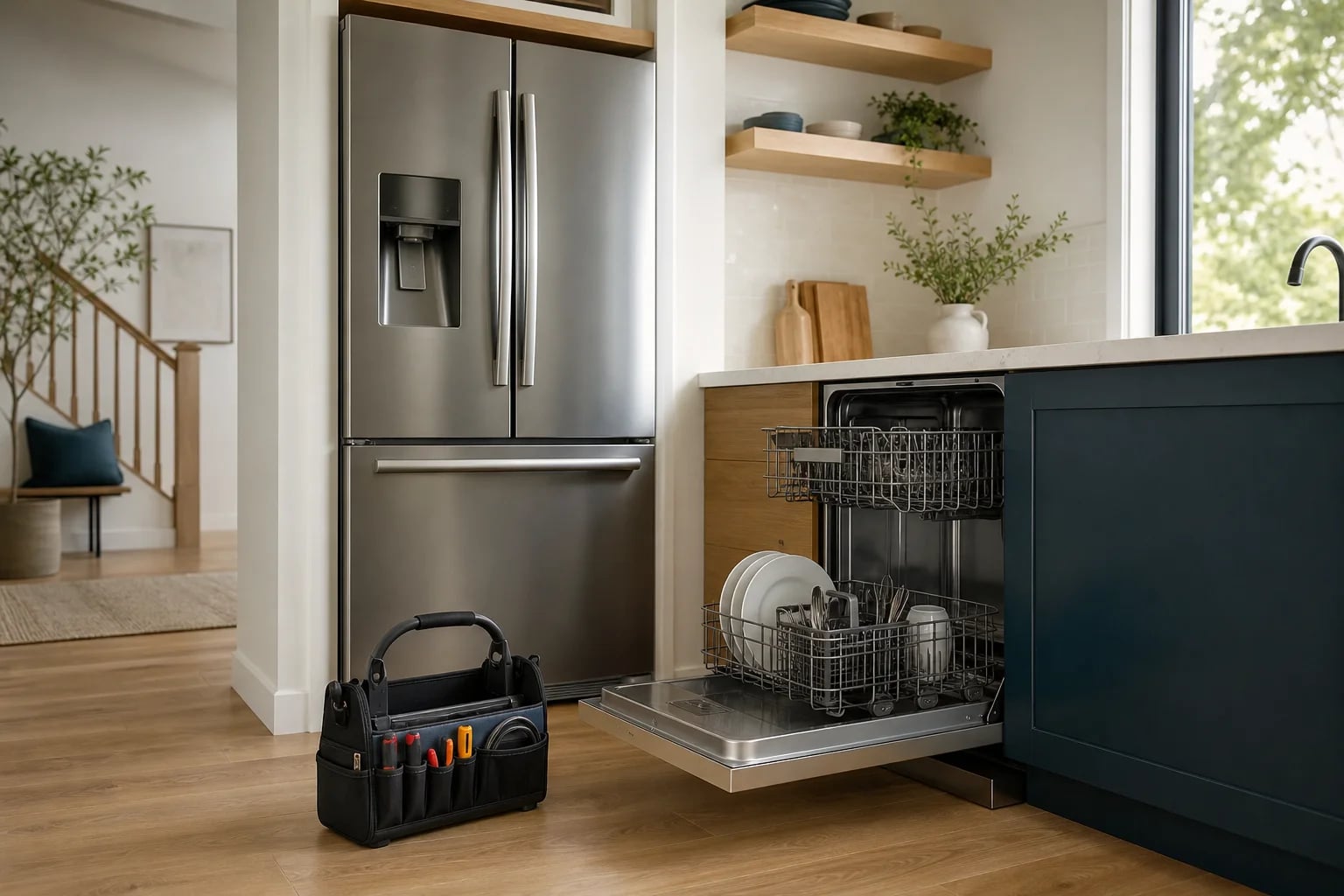
Samsung sells a full line of kitchen and laundry appliances in the United States, most of them with touch controls, Wi-Fi options and a display that shows error codes. That makes some problems easier to name and others harder to fix without a technician, because the control electronics are specific to the model.
This page covers the problems Samsung owners report most, what each usually points to, how to find the model code and manual, how the warranty works, and when an independent repair business is the right call. It is not affiliated with Samsung.
Callbook is not affiliated with, authorized by or endorsed by Samsung. This page is written for owners of its products; warranty service may need to go through the maker.
What people own
- French door, side-by-side and top-freezer refrigerators, including models with an in-door ice maker or a built-in water dispenser.
- Front-load and top-load washers, and the matching electric and gas dryers.
- Dishwashers with top-mounted or front controls.
- Freestanding and slide-in electric, gas and induction ranges.
- Over-the-range microwaves and Bespoke panel-ready models.
Common problems and what they usually point to
Ice maker stops producing or freezes over
On refrigerators with an in-door ice maker, owners report frost in the ice compartment, ice that will not drop, or an empty bin. An air leak around the ice room is the usual starting point, and the fix ranges from a reset and a new gasket to a new ice maker assembly.
Refrigerator runs but does not cool
Warm food with the compressor humming usually points to a defrost problem (frost on the evaporator), a failed evaporator fan, or a sealed-system fault.
Washer shows a drain or unbalanced-load code
Codes that relate to draining usually mean a clogged drain pump filter, a kinked hose or a failed drain pump. Codes that relate to balance usually mean an uneven load, a washer that is not level, or worn suspension parts.
Dryer runs but does not heat
On an electric dryer this is usually a failed heating element, a thermal fuse or a blocked vent. On a gas dryer it is usually an igniter, a gas valve coil or a flame sensor. A dryer that heats but takes two cycles almost always has restricted venting.
Range or oven shows a code or will not heat
A code on the display often points to a temperature sensor, a door latch or a relay on the control board. An oven that will not reach temperature usually has a failed bake element (electric) or igniter (gas).
Model numbers, manuals and warranty
- The model code and serial number are on a sticker inside the appliance: on the inside wall of a refrigerator, around the door frame of a washer or dryer, on the inside edge of a dishwasher door, or behind the oven door or storage drawer on a range. The support site searches by that code.
- Samsung publishes manuals under Manuals & Software on its support site. Search by model code, open the user manual, and look for the troubleshooting or error-code section near the end.
- A new Samsung home appliance carries a limited warranty from the date of purchase; terms differ by product, so check the warranty page in the manual. Covered repairs are arranged through Samsung and its authorized service network; an outside repair inside the warranty period may not be reimbursed.
- Samsung lists phone support at 1-800-SAMSUNG (726-7864), 24/7 chat and a text option on its contact page. Repairs can be requested and tracked online with a Samsung account; have the model code, serial number and purchase date ready.
When a local repair business is the right call
- The appliance is out of the maker's warranty and you want a repair quote rather than a replacement, or someone local who can come sooner.
- A refrigerator has a sealed-system problem (compressor, evaporator, refrigerant leak). This needs EPA-certified refrigerant handling and is never a do-it-yourself repair.
- A gas range or gas dryer needs igniter, valve or gas-line work.
- The fix involves a control board, inverter board or display, which must be matched to the exact model and often configured after installation.
Questions people ask
Does using an independent repair business void my Samsung warranty?
Under U.S. law a maker cannot void a warranty just because someone else worked on the product, but it can decline to cover damage caused by that work and will not pay for repairs it did not arrange. Inside the warranty, start with Samsung. Outside it, any qualified business can do the work.
Where do I find the error-code list for my model?
In the user manual on Samsung's support site under Manuals & Software. Search by model code and look for the troubleshooting section.
Can a local technician get Samsung parts?
Usually, yes. Pumps, elements, igniters, sensors and ice makers are sold through appliance parts distributors. Some control boards take longer to arrive.
My refrigerator is only a few years old. Is it worth repairing?
Often, yes. Fans, defrost parts, gaskets and ice makers are routine repairs. A sealed-system failure on a refrigerator near the end of its expected life is where replacement starts to make more sense.
Sources
- Samsung US Support: home page (manuals, warranty, repair requests) www.samsung.com
- Samsung US Support: Manuals & Software www.samsung.com
- Samsung US Support: Warranty information and checker www.samsung.com
- Samsung US Support: Contact Samsung www.samsung.com