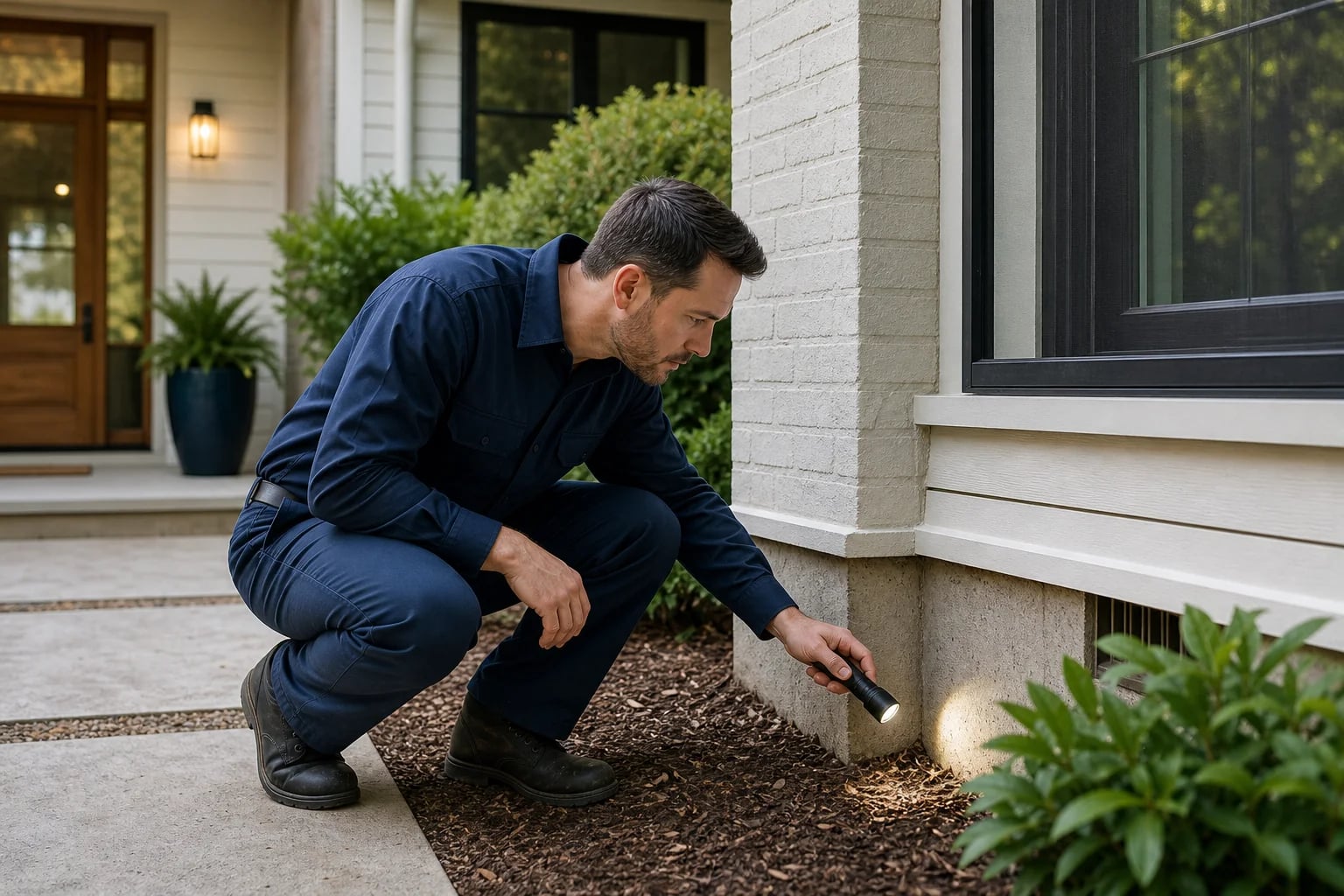
Pest control is one of the few home services where the person at your door is applying regulated chemicals inside the place you sleep and eat. That is why every state licenses pesticide applicators, and why the first question is not "how much" but "are you licensed for this." The second question is what they plan to do, because the right answer for ants in the kitchen is very different from the right answer for termites in the sill plate.
This guide explains the licenses and insurance that apply, the questions that reveal whether a company will inspect before it sprays, the red flags, how to compare treatment proposals fairly, and what to expect on the day of service.
Licenses, insurance and permits
State pesticide applicator license
Anyone applying pesticides for hire must be licensed or certified by the state, usually by the department of agriculture, in a category that matches the work: general household pests, termites and wood-destroying organisms, fumigation, lawn and ornamental. In Florida, the Department of Agriculture and Consumer Services licenses pest control businesses and the individuals who work for them, and runs a public database you can search by name. Most states have an equivalent. Ask for the license number and check it.
Business license and certified operator
In many states the company holds a separate pest control business license and must have a certified operator responsible for the technicians it sends out. A technician in training may treat under supervision; ask who holds the certification and who will actually be in your home.
General liability insurance
This covers damage to your property during treatment: a stained carpet, a dead shrub, a drilled pipe during a termite job. Ask for a certificate of insurance in the business name with current dates.
Workers’ compensation
Technicians work in attics, crawl spaces and on ladders. A company with employees should carry workers’ compensation so an injury in your home is the employer’s problem, not yours.
Termite and wood-destroying organism work
Termite treatments, and the inspection reports used in real estate sales, usually require a separate license category and come with a written contract and a renewable guarantee. Confirm the company holds that category before signing anything that mentions termites.
Industry membership
Membership in the National Pest Management Association or a state association is a sign of a business that invests in training. It is not a substitute for the state license, and the state license is not optional.
Questions to ask
- What is your license number, and which category covers the work you are proposing?
- Will you inspect my home and identify the pest before quoting, or is the price based on square footage?
- What exactly will you apply, where, and can I see the product labels?
- Do you use integrated pest management: sealing entry points, removing food and water sources, monitoring, and chemicals only where needed?
- What do I need to do before and after treatment, and how long do people and pets stay off treated areas?
- Will the written estimate come before any treatment, and does it list the number of visits and what a return visit costs if the pests come back?
- Is there a guarantee, what does it cover, how long does it last and what would void it?
- Is this a one-time treatment or a contract, and how do I cancel a recurring plan?
Red flags
- Cannot or will not produce a license number, or the number does not appear in the state lookup.
- Quotes a price over the phone, or from the size of the house, with no inspection and no identification of the pest.
- Pushes a recurring contract or a whole-house treatment for a problem confined to one room or one species.
- Cash only, full payment before treatment, or a discount that only applies if you sign today.
- Claims a secret formula, a product "too strong for the public," or a government endorsement. Agencies do not endorse companies.
- Arrives unannounced saying they were treating a neighbor and noticed a problem at your house.
- For termites: finds damage within minutes and demands an immediate decision, with no written inspection report.
Comparing quotes fairly
- Compare the diagnosis first. Each company should name the pest and say where it is getting in. If two proposals disagree about what the pest is, at least one inspection was not done properly.
- Match the scope. A one-time interior treatment is not comparable to a quarterly exterior plan with free call-backs. Put them side by side as total cost over a year.
- Look at what is non-chemical in each plan: exclusion, sanitation advice, monitoring. The plan that fixes the entry point tends to be the one that lasts.
- Read the guarantee terms rather than the word "guarantee": how long, what counts as a recurrence, what you must do to keep it, and whether the follow-up is free.
- Be cautious with the lowest bid if it also had the shortest inspection and the vaguest paperwork.
On the day
- Confirm the written estimate still matches the plan before the technician starts, including which rooms and which products.
- Follow the preparation instructions: clear under sinks, put away food and dishes, move pet bowls and bedding, and empty the areas to be treated.
- Tell the technician again about children, pregnancy, pets, fish tanks and anyone with asthma or chemical sensitivities, even if you said so on the phone.
- Get the service ticket before they leave: products used, where they were applied, re-entry time and the date of any follow-up.
- Follow the re-entry and cleaning guidance. Wiping treated baseboards the same afternoon undoes the work you just paid for.
Questions people ask
Do I need a licensed company for a small ant problem?
If anyone is applying pesticides for pay in your home, yes, in every state. For a minor problem you can also try sealing entry points, removing the food source and using over-the-counter baits according to the label. If it keeps coming back, that is when an inspection is worth paying for.
Is a recurring contract worth it?
It depends on the pest and the property. Quarterly exterior service makes sense where pressure is constant; a single targeted treatment is often enough for a one-time problem. Ask the company to justify the plan from the inspection, and never sign a contract you cannot cancel.
How do I check a license?
Search the state pesticide regulator’s public database, usually the department of agriculture. Florida’s FDACS lookup is linked below as an example. Search by company name and by the technician’s name; both should appear.
Are the products safe for my family and pets?
Every product has a label that states where it may be used and how long to stay away. Ask to see it. A company that practices integrated pest management uses the least amount of product needed and tells you plainly what the risks are and how to reduce them.
Sources
- U.S. EPA: Tips for selecting a pest control service www.epa.gov
- Florida FDACS: Pest control licensing and the public license database www.fdacs.gov
- UF/IFAS Extension: Homeowner’s guide to selecting a pest control service ask.ifas.ufl.edu
- National Pest Management Association (PestWorld): Choosing a pest control company www.pestworld.org