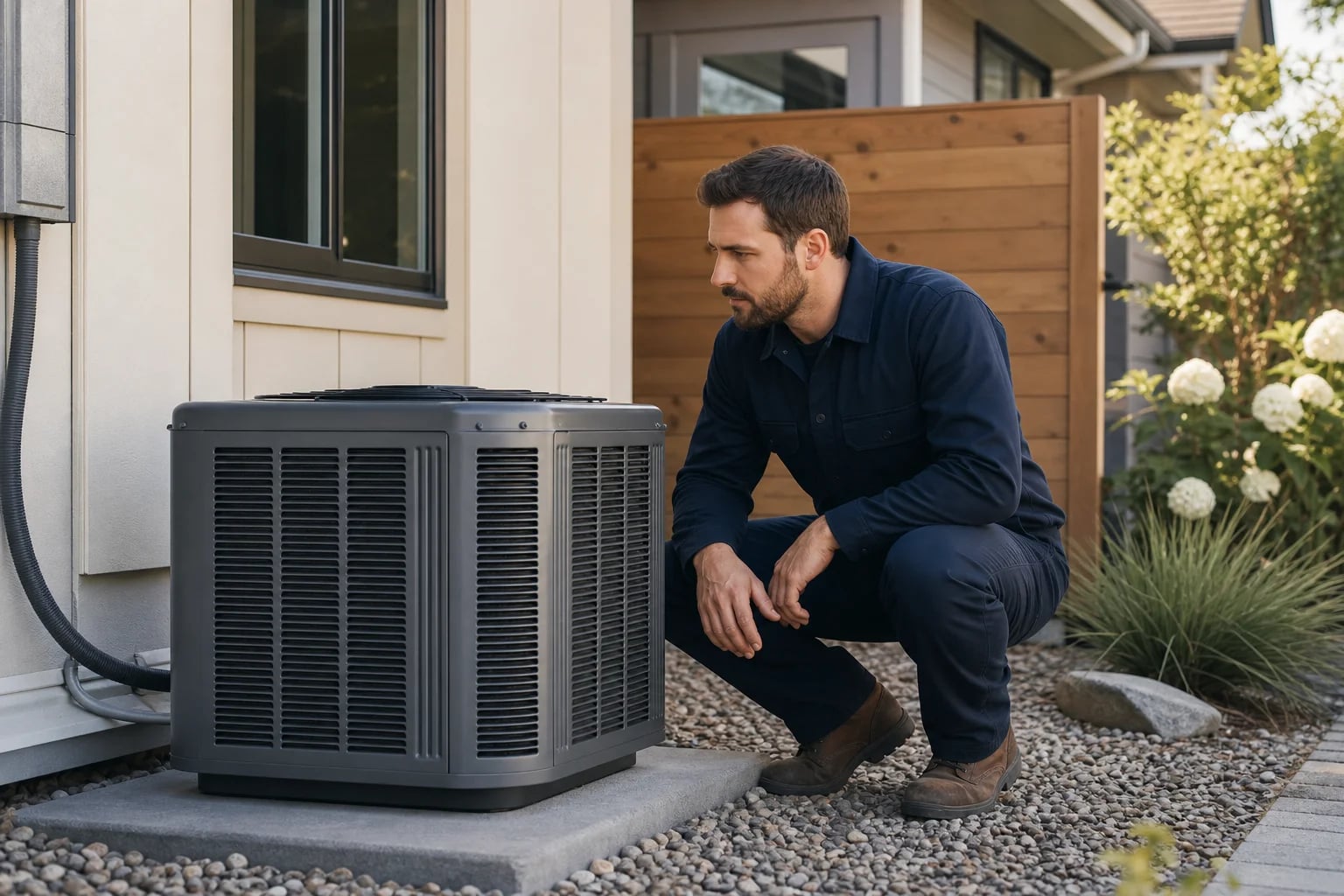
Carrier is one of the oldest names in residential heating and cooling, and its equipment is installed through a dealer network rather than sold in stores. If you own a Carrier system, the outdoor unit, the indoor coil or air handler, the furnace and the thermostat were probably chosen and set up as a matched set.
This page is written for the owner, not the dealer: the products people have, the problems that come up most, where the model and serial numbers are, how the warranty works, and when to call a repair business. Callbook is not affiliated with Carrier and nothing here is an endorsement by the company.
Callbook is not affiliated with, authorized by or endorsed by Carrier. This page is written for owners of its products; warranty service may need to go through the maker.
What people own
- Infinity series split air conditioners and heat pumps, usually paired with an Infinity control (thermostat)
- Performance and Comfort series air conditioners and heat pumps
- Gas furnaces in the same three tiers, including variable-speed and modulating models
- Air handlers and evaporator coils that sit on top of or next to the furnace
- Ductless mini-split systems with wall-mounted indoor heads
Common problems and what they usually point to
Outdoor unit hums but the fan does not spin, or the system short-cycles
The run capacitor is the usual suspect. It is a small cylinder in the outdoor unit that gives the fan and compressor a starting push. When it weakens, the fan stalls or the compressor trips on overload. It is a quick swap for a technician but it carries a dangerous charge, so it is not a homeowner part.
Outdoor unit will not start at all, or will not shut off
The contactor is the relay that sends power to the compressor and fan when the thermostat calls, and its contacts pit and burn over years of cycling. Stuck closed, it keeps the unit running after the thermostat is satisfied; burned open, it does nothing.
Cooling is weak, the indoor coil ices up, or the system runs constantly
Low refrigerant from a leak is the common cause once a dirty filter and blocked coil are ruled out. Refrigerant does not get used up, so low charge means a leak at a joint, a coil or a line. Finding and fixing the leak, then charging to the maker's specification, is licensed work.
Little or no air at the vents even though the system is running
The indoor blower motor, its capacitor or the control that drives it has failed, or the filter and coil are badly restricted. Variable-speed blowers in the higher tiers use an electronic motor module that is replaced as a unit.
Furnace clicks, tries to light and shuts down, or blinks a code
Carrier furnaces flash a fault code on an LED visible through the blower door window, with the legend on a label inside the door. A dirty flame sensor, a failed hot-surface igniter, a stuck pressure switch or a blocked condensate trap are the common causes behind the codes.
Model numbers, manuals and warranty
- The model and serial numbers are on a rating plate: on the outdoor unit near the refrigerant line connections, on a furnace inside the upper door, and on an air handler inside the access panel. Photograph it before you call anyone.
- Owner's manuals and product data are on Carrier's product documents search, which asks for the model number. The furnace fault-code legend is printed inside the blower door.
- Carrier asks owners to register residential equipment within 90 days of installation. On its warranty page, registration lets you choose between a 10-year parts-only limited warranty and a 5-year parts plus 3-year labor option through a participating dealer; unregistered equipment carries a 5-year parts-only warranty. Labor is not included with the parts warranty.
- Carrier's warranty lookup tool takes the serial number and shows the coverage on record, which is worth doing before a repair so you know whether a part should be free.
- Warranty parts are supplied through a Carrier dealer, so even a covered part needs a technician visit and the labor is usually billed unless a labor plan is in place. Carrier does not sell parts to the public.
When a local repair business is the right call
- Anything involving refrigerant: a suspected leak, an iced coil that keeps coming back, or a system that cools poorly. Federal law requires EPA Section 608 certification for anyone who opens the refrigerant circuit.
- Gas furnace faults, a smell of gas, soot, or a carbon monoxide alarm. Leave the house and call the gas utility first if you smell gas; a licensed technician handles the furnace.
- The outdoor unit hums, buzzes or trips the breaker. Capacitors and contactors are inexpensive parts but they sit on live high-voltage circuits.
- Any part that may be under warranty. The part itself may be free, but it has to be ordered and installed by a dealer or licensed contractor, and the diagnosis is still a service call.
Questions people ask
Does the Carrier warranty cover labor?
Not by default. Carrier's standard coverage is parts only. The labor option Carrier describes is a choice at registration through participating dealers, and some dealers sell their own labor plans. Expect to pay for the service call and the labor on a parts-warranty repair.
My system was installed by the previous owner. Am I still covered?
Often at a reduced level. Carrier's longer registered coverage applies to the original owner; what transfers depends on the certificate for your model. Run the serial number through the warranty lookup to see what is on record.
Can any HVAC company work on a Carrier system?
Yes. Any licensed heating and cooling contractor can diagnose and repair it. Warranty parts, though, are processed through Carrier dealers, so for a covered part a Carrier dealer saves a step.
What does the blinking light on my Carrier furnace mean?
It is a fault code. Count the flashes and compare them with the legend on the inside of the blower door or in the owner's manual. Write down the code before turning the power off, because resetting the furnace clears it.
Sources
- Carrier: Residential warranty information www.carrier.com
- Carrier: Homeowner resources www.carrier.com
- Carrier: Product documents search www.carrier.com
- U.S. EPA: Section 608 technician certification requirements www.epa.gov