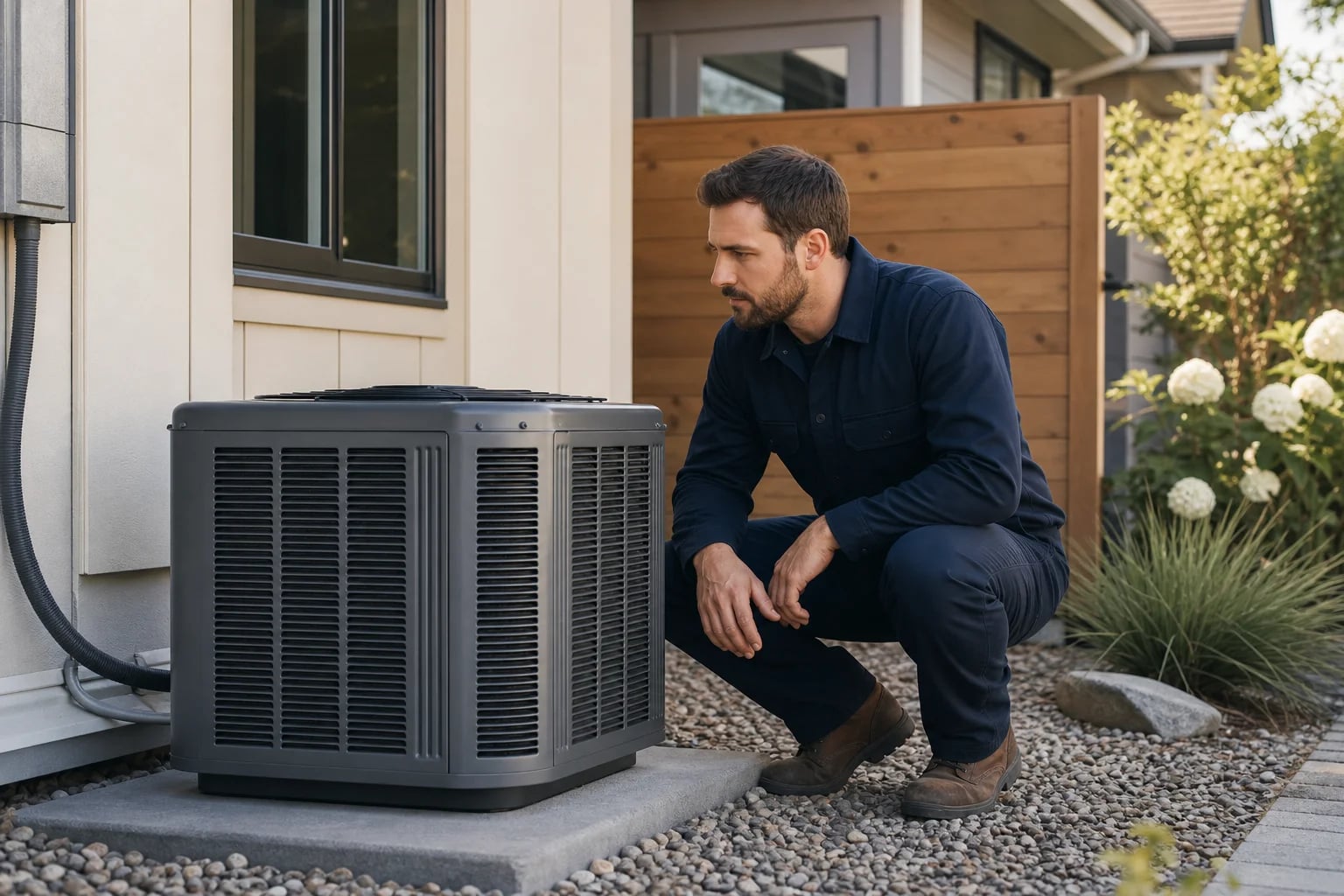
Central air conditioning is the most expensive system in most homes to replace, which is exactly why the repair-or-replace question matters more here than for a dishwasher. Get it right and you spend a few hundred dollars on a capacitor and go on for years. Get it wrong and you pay for a major repair on a unit that fails again the next summer.
The decision rests on four things: how old the system is, what failed, what refrigerant it uses, and how much a replacement would actually cost once the indoor and outdoor units, labor and permits are counted. Efficiency and rebates come after those, as a tiebreaker. This article walks through each, lists the repairs routinely worth doing and the ones that usually are not, and explains what a technician’s estimate should tell you.
Typical service life
ENERGY STAR advises homeowners to consider replacing a central air conditioner or heat pump that is more than ten years old, and to think about replacement sooner if it needs frequent repairs or energy bills are climbing. That ten-year mark is guidance about when to start weighing the decision, not a prediction that the unit will fail then. Many systems run well beyond it, particularly in milder climates and with yearly maintenance.
Climate is the biggest variable. A condenser that runs seven months a year in a hot, humid region ages faster than one that runs three months in the north, and salt air and clogged coils shorten life further. The manufacturing date is on the outdoor unit’s data plate, usually encoded in the serial number.
Repairs that are usually worth it
Most no-cool calls in summer are one of these, and they are repairs you should expect to make on any system of any age that is otherwise sound.
- Capacitor. The single most common outdoor-unit failure. The fan or compressor hums but will not start. Quick and inexpensive.
- Contactor or relay. The outdoor unit does not start at all, or will not shut off.
- Condenser fan motor. The compressor runs but the fan does not, and the unit overheats and trips off.
- Blower motor or blower capacitor on the indoor unit.
- Thermostat, control board, low-voltage wiring fault, or a clogged condensate drain tripping the float switch.
- Dirty coils or a severely restricted filter. Maintenance, but often the whole problem.
Repairs that usually are not
The expensive failures are in the refrigerant circuit. Under U.S. EPA rules, only a certified technician may recover or charge refrigerant, and the work takes equipment and time. On an older system these repairs often cost a large fraction of a new one.
- A failed compressor out of warranty. The part, the labor, a new filter-drier and a full refrigerant charge add up quickly. Many manufacturers warranty the compressor itself for several years beyond the base warranty, so check the registration date before assuming it is uncovered.
- A refrigerant leak in the evaporator coil or condenser coil. The coil replacement is large, and on a system using an older refrigerant the recharge is expensive as well.
- Repeated "top-offs" of refrigerant. A system is sealed and should not need refrigerant. Paying to add it each spring is paying for a leak you have not fixed.
- Any major repair on a system that uses R-22, which is no longer produced in the U.S. and is costly to source. A big repair on R-22 equipment is nearly always money better spent on replacement.
The fifty-percent rule of thumb
The common rule of thumb says that if the repair will cost more than about half of a replacement system, and the unit is past the midpoint of its typical life, replacement is the better investment. For air conditioning the rule works best when both sides of the comparison are honest: the replacement price should be an installed price for a matched indoor and outdoor system, including any ductwork, electrical or permit costs, not just the outdoor unit.
It is a rough tool. The point is that a modest repair on an older system is fine, a major repair on an older system usually is not, and a major repair on a young system under warranty is usually fine. The judgment comes in the middle.
Efficiency, refrigerants and rebates
New systems meet federal minimum efficiency standards that are higher than those of a decade or more ago, so a replacement usually uses less electricity per hour of cooling. How much that saves depends on your climate, your rates and how well the new system is sized and installed; ENERGY STAR warns that poor installation can cut efficiency substantially, which is why the installer matters as much as the equipment.
Refrigerant is changing too. The U.S. EPA is phasing down HFC refrigerants and new residential systems are moving to newer ones. That does not make an existing system unserviceable, but it affects the long-term cost of refrigerant repairs on older equipment. Rebates vary by utility and change often; check the ENERGY STAR rebate finder and your utility when you are deciding.
What a technician’s estimate should tell you
Before approving a significant AC repair, you should have clear answers to these.
- The failed component and the test that confirmed it. A compressor should be condemned on measured electrical and pressure readings, not a hunch.
- Whether the refrigerant circuit is involved, what refrigerant the system uses, and whether a leak was found and where.
- The system’s age from the data plate and the warranty status of the failed part, including any registered extended compressor warranty.
- Parts, labor and refrigerant listed separately, the diagnostic fee and whether it is credited, and the warranty on the repair.
- If replacement is suggested: a load calculation to size the new system, the matched indoor and outdoor equipment, its efficiency rating, and every extra line item.
What to do while you decide
If the outdoor unit is grinding or screaming, or the breaker keeps tripping, shut the system off at the thermostat and leave it off; running it can turn a small failure into a compressor failure. Check the filter and the breaker, and make sure the outdoor unit is not buried in debris. Use fans and close blinds on the sunny side. Photograph the outdoor unit’s data plate and the indoor unit’s label so a second opinion can be priced without another visit.
Questions people ask
My AC is 14 years old and needs a capacitor. Replace the whole system?
No. A capacitor is a small repair that makes sense at almost any age. Use the visit to ask how the compressor and coils look so you can plan ahead.
The technician says the compressor failed. What now?
Ask for the readings that condemned it, check whether the compressor is under an extended warranty, and get an installed price for a replacement system. On a unit past ten years, or any R-22 unit, replacement usually wins.
Can I just add refrigerant every year?
You can, but it means you have a leak and you are paying for refrigerant and labor every season. Have the leak located. If it is in a coil on an older system, that is usually the point to replace.
Sources
- ENERGY STAR: When is it time to replace? (heating and cooling equipment) www.energystar.gov
- U.S. EPA: Section 608 technician certification (refrigerant handling) www.epa.gov
- U.S. EPA: Phasedown of hydrofluorocarbons (HFC refrigerants) www.epa.gov
- Air Conditioning Contractors of America (ACCA): contractor standards and locator www.acca.org