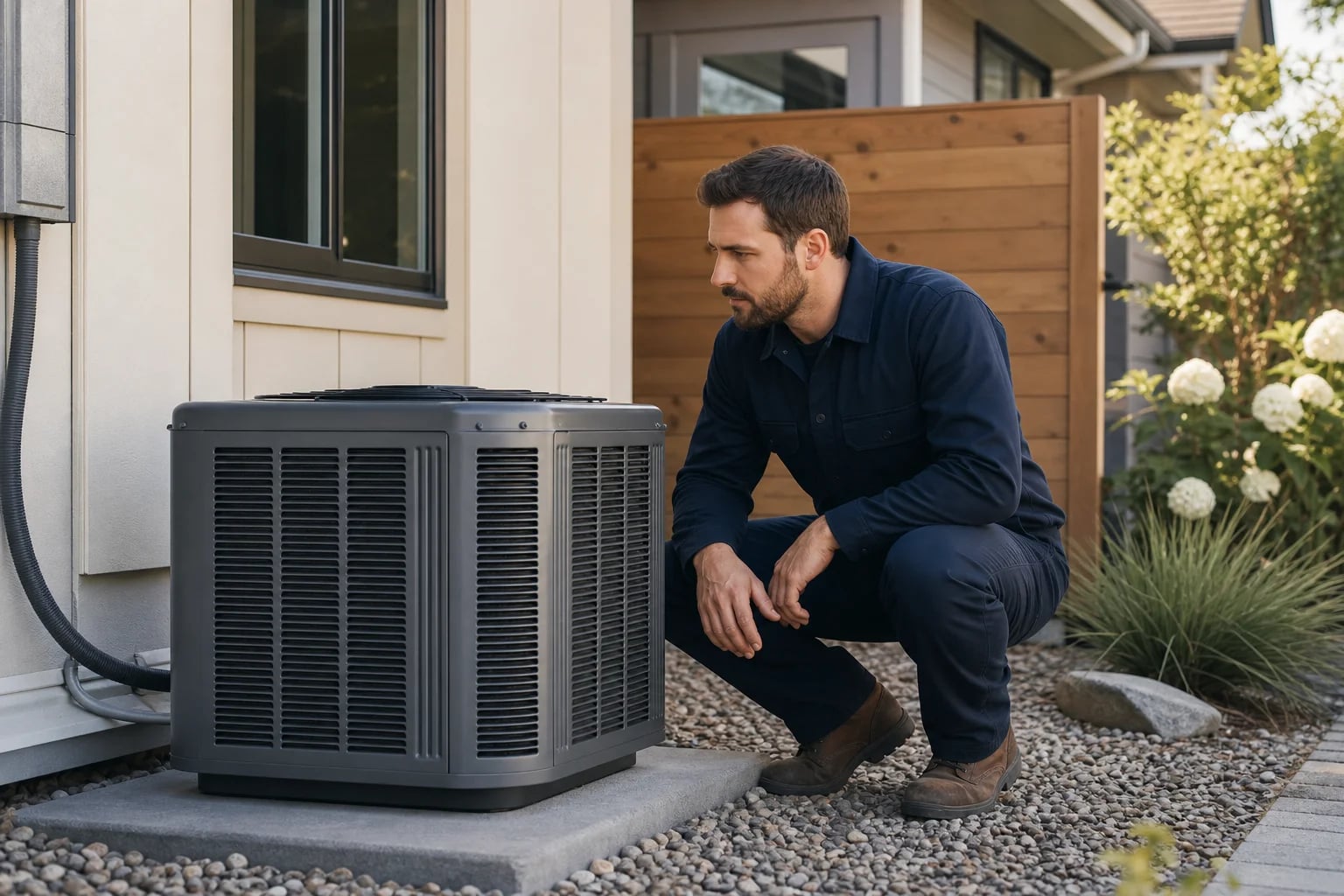
American Standard Heating and Air Conditioning is the sister brand of Trane, and the two share engineering, parts and much of their support structure. The equipment is sold and installed through independent dealers.
This page covers the equipment American Standard owners usually have, the faults that come up most, where the rating plate and manuals are, how the warranty and registration work, and when a repair business is the right call. Callbook is not affiliated with American Standard and this page is not an endorsement by the company.
Callbook is not affiliated with, authorized by or endorsed by American Standard. This page is written for owners of its products; warranty service may need to go through the maker.
What people own
- Platinum series split air conditioners and heat pumps, including variable-speed models
- Gold and Silver series air conditioners and heat pumps
- Gas furnaces in matching tiers, including two-stage and modulating models
- Air handlers and cased evaporator coils
- Packaged units combining heating and cooling
- Ductless mini-split systems
- AccuLink and other American Standard thermostats and controls
Common problems and what they usually point to
Outdoor unit hums, will not start, or starts and stops
A weak run capacitor or a burned contactor explains most of these. Both are inexpensive parts that a technician replaces in minutes, and both sit on live high-voltage circuits.
Air conditioner runs but the house will not cool
A refrigerant leak once a clogged filter and a dirty outdoor coil are ruled out. Ice on the indoor coil or the line set points the same way. The leak is repaired first, then the system is charged to specification.
No airflow, or the blower runs nonstop
The indoor blower motor, its capacitor or the control board. Variable-speed motors are replaced as a module. A blower that will not stop often traces to a stuck relay or a fan setting on the thermostat.
Furnace lights briefly and shuts off, showing a blink code
The furnace flashes a status code on an LED visible through the door, with the legend on the door label. Causes behind the code are usually a dirty flame sensor, a failed igniter, a pressure switch that will not close or a limit opening because airflow is low.
Communicating control shows an error or loses a component
A loose wire on the data link, a failed board or a power interruption. Standard thermostats more often need batteries or a wiring check.
Heat pump iced over or delivering lukewarm air in winter
A defrost control, a reversing valve or low refrigerant. Some cool air and steam during a defrost cycle is normal; a coil that stays encased in ice is not.
Model numbers, manuals and warranty
- The model and serial numbers are on a nameplate: on the outdoor unit near the refrigerant connections, on a furnace inside the upper door, and on an air handler on the cabinet or inside the panel. The warranty lookup needs the serial number.
- Owner's manuals are posted on American Standard's owner's support page by product type (heating and cooling systems, packaged units, thermostats, filters, humidifiers). The furnace fault-code legend is also on the label inside the furnace door.
- American Standard's warranty page describes a Registered Limited Warranty, which extends parts coverage to 10 years when the equipment is registered within 60 days of installation, and a Base Limited Warranty, typically five years, for unregistered equipment.
- Neither warranty covers labor; the owner pays labor and shipping. The page says an Optional Extended Warranty bought through a dealer may include labor depending on the plan.
- To look up coverage, enter your last name and the serial number on the warranty and registration page, which also lists a phone number for registration help.
- American Standard's customer care page lists a phone number with weekday hours. Parts are supplied through dealers, not sold to the public.
When a local repair business is the right call
- Any refrigerant work. Only EPA Section 608 certified technicians may open the circuit.
- Gas furnace faults, a gas smell, or a carbon monoxide alarm. For gas, leave and call the utility first.
- A humming, buzzing or breaker-tripping outdoor unit. Capacitors and contactors are live high-voltage parts.
- A warranty part. It is claimed through an American Standard dealer and installed by a technician whose labor is billed.
- A communicating system showing errors. The diagnosis needs the dealer tools and documentation.
Questions people ask
Does the American Standard warranty include labor?
No. The Base and Registered Limited Warranties cover parts; the owner pays labor and shipping. Only a separately purchased extended plan might include labor.
I missed the 60-day registration window. What do I have?
The Base Limited Warranty, which the company says typically lasts five years on parts. Some states restrict warranties that depend on registration; check the certificate for your model and state.
Is American Standard the same as Trane?
They are sister brands under the same parent and share engineering and parts. Warranty terms, dealers and registration are handled under each brand's own name, so use American Standard's pages for American Standard equipment.
Can any HVAC company repair it?
Yes. Any licensed HVAC contractor can diagnose and repair it. Warranty parts are claimed through American Standard dealers, so for a covered part a dealer is the shorter path.
Sources
- American Standard: Warranty and registration www.americanstandardair.com
- American Standard: Owner's support and manuals www.americanstandardair.com
- American Standard: Customer care www.americanstandardair.com
- U.S. EPA: Section 608 technician certification requirements www.epa.gov